
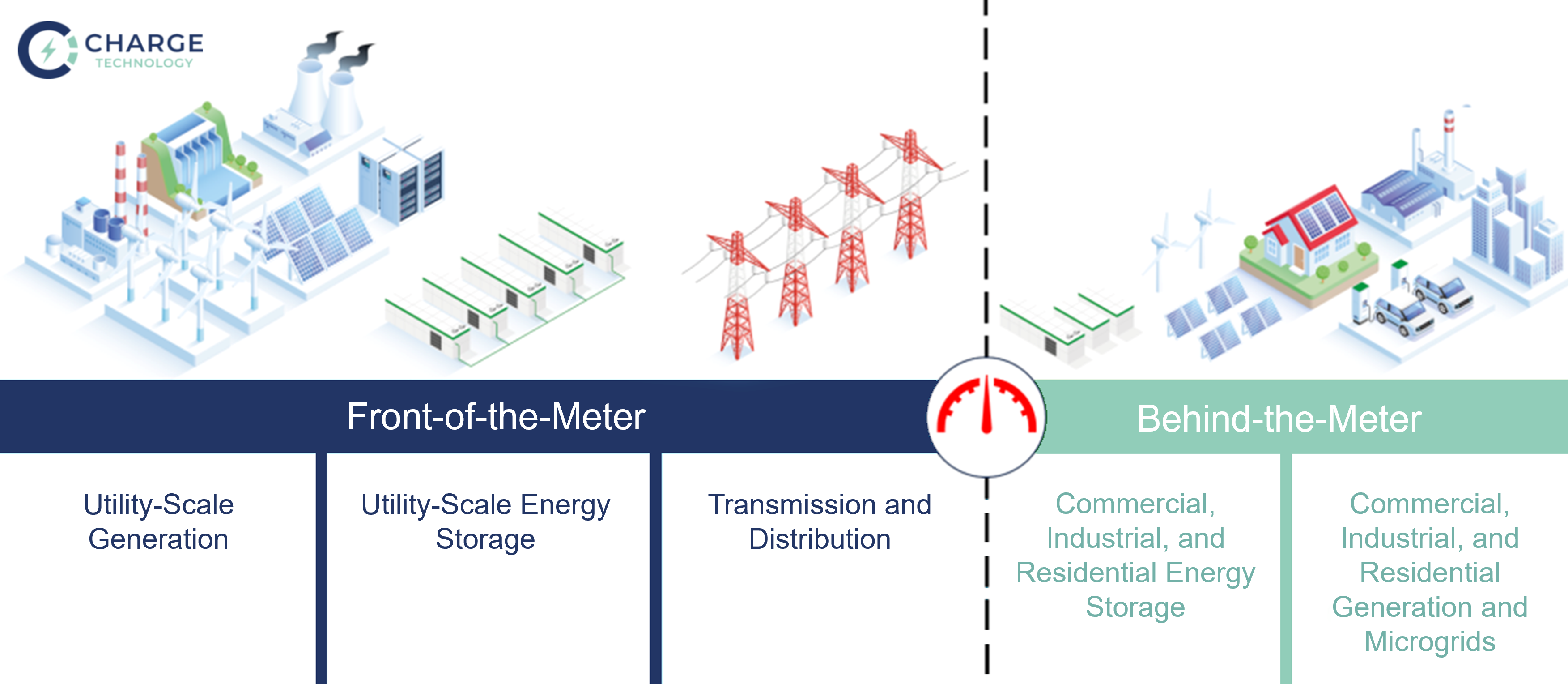
In the world of battery energy storage systems (BESS), one of the most fundamental distinctions is where the system sits in relation to the utility meter. This single boundary, the point of common coupling between a building or project and the electrical grid, divides the entire BESS landscape into two distinct paradigms: Behind-the-Meter (BTM) and Front-of-the-Meter (FTM).
For commercial and industrial (C&I) energy managers, real estate developers, or project developers, understanding the differences between Behind-the-Meter and Front-of-the-Meter is not merely academic. These two deployment models differ dramatically in their revenue streams, regulatory requirements, investment structures, risk profiles, and the skill sets needed to execute them successfully.
This guide unpacks both models in depth, exploring how each works, where the value lies, and what practical considerations you need to evaluate before committing capital to a battery storage project.
What Is Behind-the-Meter (BTM)?
Behind-the-Meter energy storage refers to a battery system installed on the customer’s side of the utility meter, within the electrical system of a home, commercial building, industrial facility, or campus. In this model, the battery primarily serves the site host’s energy needs. Energy is charged from the local grid or on-site generation (such as rooftop solar), and discharged to offset the facility’s consumption.
BTM systems are typically sized to match the load profile of the specific building or operation. A 500 kW / 1 MWh BESS at a hospital, for instance, might be designed to reduce the hospital’s peak demand charges and provide backup power during outages. The primary beneficiary of the system’s value is the energy user at that site.
BTM at a Glance
Location: Customer side of the utility meter
Primary value: Demand charge reduction, energy arbitrage, backup power, solar self-consumption
Primary beneficiary: The on-site energy consumer (building owner, tenant, manufacturer)
Typical size: 50 kWh to 10+ MWh, depending on facility type
Revenue model: Utility bill savings, possibly wholesale market participation
What Is Front-of-the-Meter (FTM)?
Front-of-the-Meter battery storage refers to battery systems that are connected to the grid on the utility or transmission side of the meter. These systems are standalone grid assets; they are not primarily intended to serve an individual building’s load. Instead, they participate in wholesale electricity markets, provide grid services, or are owned and dispatched by utilities to meet system-wide needs.
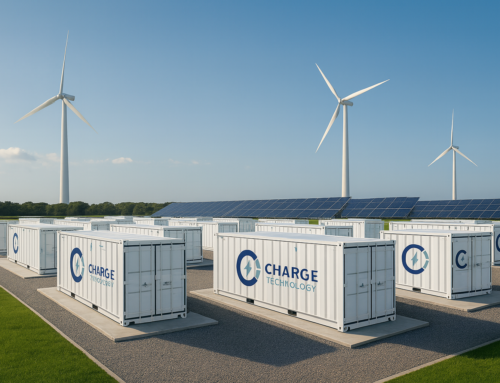
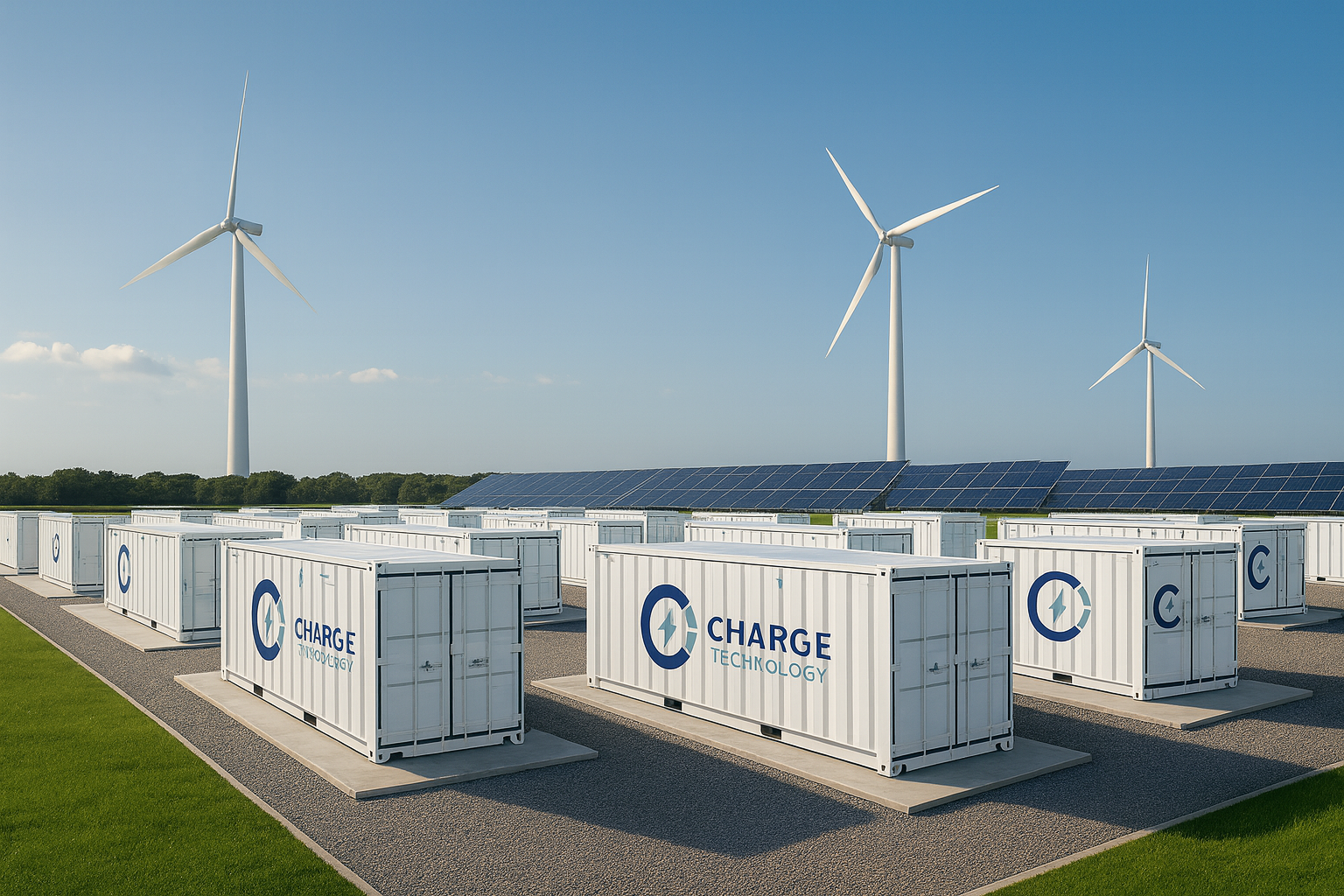
Front-of-the-Meter projects are fundamentally infrastructure investments. A 100 MW / 400 MWh standalone battery energy storage plant, for example, might be co-located with a utility-scale solar farm and contracted to provide capacity, frequency regulation, and energy arbitrage services to the regional grid operator.
FTM at a Glance
Location: Grid side of the utility meter, often at transmission or distribution level
Primary value: Wholesale energy arbitrage, ancillary services, capacity, grid deferral
Primary beneficiary: The grid, utility ratepayers, and the project’s investor/owner
Typical size: 1 MWh to 500+ MWh
Revenue model: Wholesale market revenues, tolling agreements, capacity contracts, utility offtake
The Meter as a Regulatory and Economic Boundary
The utility meter is not merely a physical device; it represents a regulatory boundary with profound economic consequences. Tariff structures, interconnection rules, market participation eligibility, and ownership models are all determined, at least in part, by which side of the meter a storage asset sits on.
In the United States, for instance, FERC Order 841 (2018) mandated that regional transmission organizations (RTOs) and independent system operators (ISOs) remove barriers preventing electric storage resources from participating in wholesale energy, capacity, and ancillary services markets. This opened the door for BTM resources to participate in FTM markets under certain conditions, a development that continues to blur the hard boundary between the two models.
Understanding both sides of this boundary is essential for any developer, investor, or corporate energy manager looking to maximize the value of a storage asset.
Behind-the-Meter Applications
Demand Charge Reduction
Demand charges are fees utilities levy based on a customer’s peak electricity consumption during a billing period, typically measured in 15-minute or 30-minute intervals. For large commercial and industrial customers, demand charges can represent 30% to 70% of their total electricity bill.
A Behind-the-Meter battery system can dramatically reduce these charges by detecting when a facility’s demand is approaching its peak threshold and discharging stored energy to shave that peak. This prevents a costly spike from being recorded on the utility meter. Even small reductions in peak demand, sometimes just a few kilowatts, can yield thousands in monthly savings.
Practical Example: Food Processing Plant
Consider a food processing plant in California paying a demand charge of $18/kW per month. During summer afternoons, its production equipment drives peak demand to 850 kW, resulting in $15,300 in demand charges for that month. A 250 kW / 500 kWh BESS installed behind the meter could target and shave the top 200-250 kW of those peaks, potentially reducing the monthly bill by $3,600-$4,500, a meaningful annual saving of $43,000-$54,000.
Energy Arbitrage (Time-of-Use Optimization)
Many utilities offer Time-of-Use (TOU) tariffs in which electricity prices vary throughout the day, typically with higher prices during afternoon or evening peaks and lower prices overnight. A Behind-the-Meter battery energy storage system can be programmed to charge during low-price periods and discharge during high-price periods, effectively allowing the building owner to buy cheap electricity and avoid expensive peak electricity.
As battery costs continue to decline and TOU spreads widen in many jurisdictions, energy arbitrage has become an increasingly important BTM value stream — particularly in regions with aggressive renewable energy mandates that create wide price differentials between midday solar peaks and evening demand peaks.
Backup Power and Resilience
For facilities where power continuity is critical, such as hospitals, data centers, emergency services, water treatment plants, cold storage facilities, etc., a BESS can serve as an uninterruptible power supply (UPS) capable of sustaining operations for hours or even days during a grid outage. Unlike diesel generators, battery backup can activate within milliseconds and operates silently without combustion emissions.
The rising frequency of extreme weather events, wildfires, and aging grid infrastructure has made resilience a top-tier consideration for many C&I customers, sometimes justifying a storage investment on backup power value alone.
Practical Example: Data Center Campus
A Tier III data center campus in Texas, where grid reliability became front-page news during the 2021 winter storm, deploys a 2 MW / 8 MWh BESS as part of its resilience strategy. The system provides instant backup if grid power fails, eliminating the 10-second gap between grid outage and diesel generator startup. During normal operations, the same system participates in ERCOT’s ancillary services markets, generating approximately $180,000 per year in grid services revenue that partially offsets the system’s capital cost.
Solar Self-Consumption Optimization
When paired with rooftop or ground-mount solar PV, a BTM battery enables facilities to maximize the use of their own generated electricity. Without storage, any solar generation that exceeds on-site consumption at a given moment must be exported to the grid, often at low or net-metering rates. A paired battery captures the excess generation and stores it for later use, increasing the effective self-consumption rate and improving the economics of the overall solar investment.
This is particularly valuable in states or countries that have reduced or eliminated net metering compensation, making exported solar power relatively worthless compared to the avoided cost of purchasing grid power.
Participation in Demand Response Programs
Many utilities and grid operators offer Demand Response (DR) programs that pay customers to reduce or shift their electricity consumption during high-demand grid events. BTM BESS systems can participate in these programs automatically, responding to a utility signal by discharging to reduce net grid imports, effectively providing a demand-reduction event without disrupting facility operations.
In some markets, virtual power plant (VPP) aggregators bundle multiple Behind-the-Meter systems to meet minimum participation thresholds for wholesale market programs, enabling smaller facilities to access revenue streams previously available only to large commercial or industrial players.
| BTM Application | Primary Value Driver | Typical Annual Value |
|---|---|---|
| Demand Charge Reduction | Utility bill savings | $20,000-$200,000+ depending on peak demand |
| TOU Energy Arbitrage | Buy low / sell high on electricity | $10,000-$80,000 per MW |
| Backup Power / Resilience | Risk avoidance, insurance value | Variable; high for critical facilities |
| Solar Self-Consumption | Maximize on-site solar economics | Improves solar IRR by 2-5% |
| Demand Response / VPP | Grid services revenue | $30,000-$100,000 per MW per year |
Front-of-the-Meter Applications
Wholesale Energy Arbitrage
At the grid scale, energy arbitrage involves charging the battery when wholesale electricity prices are low (typically during periods of excess renewable generation or low demand overnight) and discharging when prices are high (peak demand periods, evening hours, or during grid stress events).
The profitability of wholesale arbitrage is highly dependent on the volatility and spread of locational marginal prices (LMPs) in a given market. Markets with high renewable penetration, such as California (CAISO), Texas (ERCOT), and parts of Europe, tend to exhibit increasingly negative or near-zero prices during midday solar hours and sharp price spikes in the late afternoon and evening, creating attractive arbitrage windows.
Practical Example: 100 MW Standalone BESS in ERCOT
A 100 MW / 400 MWh BESS project in West Texas charges during hours when wind generation floods the market and prices fall to $5-$20/MWh, then discharges during late afternoon and evening hours when ERCOT prices regularly spike to $150-$500/MWh or higher. With an annual average price spread of $40-$70/MWh and a round-trip efficiency of 85-88%, the project can generate $12-$25 million per year in gross arbitrage revenue, before operating costs.
Ancillary Services: Frequency Regulation
Battery storage is uniquely well-suited to provide frequency regulation, the moment-to-moment balancing of electricity supply and demand to maintain grid frequency at 50 or 60 Hz. Batteries can respond to frequency deviations in milliseconds, far faster than gas turbines or hydropower plants. In many markets, frequency regulation commands the highest per-MW revenue of any storage application.
FERC Order 755 in the U.S. established a pay-for-performance standard for frequency regulation that strongly favors fast-responding resources like batteries. In the PJM market, for example, frequency regulation has historically been among the highest-value applications for grid-scale storage.
Capacity Markets and Resource Adequacy
Capacity markets exist in many grid regions to ensure sufficient generation resources are available to meet peak demand, typically several years in advance. Storage assets can qualify to sell capacity into these markets, receiving a predictable revenue stream in exchange for a commitment to be available to discharge during high-demand periods (often called a ‘capacity tag’).
The qualification rules for storage in capacity markets vary by region and have evolved significantly as regulators grapple with how to treat the limited duration of battery systems. PJM, ISO-NE, NYISO, and MISO all have distinct rules governing the capacity value of storage assets, and this is an area of ongoing regulatory development.
Transmission and Distribution (T&D) Deferral
Grid operators and utilities face a perpetual challenge: when load growth threatens to exceed the capacity of existing transmission or distribution infrastructure, they must either build new lines and substations (expensive, slow, permitting-intensive) or find alternatives. Battery storage can serve as a non-wires alternative (NWA), providing localized capacity that defers or avoids the need for traditional T&D upgrades.
Utilities or third-party developers may contract a Front-of-the-Meter battery energy storage specifically to address a congested distribution circuit or transmission constraint. The battery charges during off-peak hours when the circuit has spare capacity and discharges during peak hours to prevent the constraint from binding.
Practical Example: Utility NWA Project
A mid-Atlantic utility faced a $45 million distribution substation upgrade driven by load growth in a suburban area. A third-party developer proposed a 10 MW / 40 MWh BESS sited near the constrained substation. Under a 10-year contract, the battery provides 8 MW of peak shaving for approximately 150 high-demand hours per year. The utility avoids the substation upgrade for 8-10 years, and the developer earns a contracted revenue stream of $1.8 million per year, effectively a win-win that ratepayers fund at a fraction of the traditional infrastructure cost.
Renewable Energy Firming and Co-location
As renewable energy developers face increasing curtailment (when solar or wind generation exceeds grid demand and must be turned off) and declining merchant revenues due to the ‘cannibalization effect’ of solar on midday prices, co-locating battery storage with renewable generation has become a standard development strategy.
A co-located BESS allows a solar or wind project to ‘firm’ its output, charging excess generation that would otherwise be curtailed and discharging during higher-price hours. This improves the project’s revenue profile and, in some cases, allows it to qualify for capacity market revenues or long-term power purchase agreements (PPAs) with utilities that require guaranteed delivery.
| FTM Application | Revenue Mechanism | Key Market / Buyer |
|---|---|---|
| Wholesale Energy Arbitrage | LMP price spread capture | Wholesale energy market (ERCOT, CAISO, PJM) |
| Frequency Regulation | Ancillary services payments | Grid operator (ISO/RTO) |
| Capacity Markets | Capacity auction revenues | ISO/RTO capacity markets |
| T&D Deferral / NWA | Contracted utility payments | Regulated utility |
| Renewable Firming | Improved PPA / merchant value | Offtake buyer / merchant market |
| Voltage Support / Reactive Power | Ancillary/technical services | Grid operator / utility |
BTM Vs. FTM: A Direct Comparison
Business Model and Revenue Stacking
One of the most important distinctions between BTM and FTM is how each model generates revenue. BTM systems primarily deliver value through utility bill savings, a relatively predictable, site-specific benefit. FTM systems generate revenue by participating in wholesale markets, which can be highly volatile and subject to market rule changes.
Both models benefit from ‘value stacking’, layering multiple revenue streams from a single battery asset. A BTM system might simultaneously capture demand charge reduction, TOU arbitrage, backup power value, and demand response revenue. A FTM system might stack energy arbitrage, frequency regulation, capacity, and renewable firming.
| Behind-the-Meter (BTM) | Front-of-the-Meter (FTM) |
|---|---|
| Bill savings for on-site host | Wholesale market revenues |
| Demand charge reduction (30-70% of bill) | Energy arbitrage on LMP spreads |
| TOU energy cost avoidance | Ancillary services (frequency reg, spinning reserve) |
| Resilience / backup power value | Capacity market payments |
| Demand response program revenue | Transmission deferral contracts |
| Solar self-consumption improvement | Renewable energy firming |
| Typically 50 kWh – 10 MWh | Typically 1 MWh – 500+ MWh |
| Lower capital absolute, higher $/kWh | Higher absolute capital, lower $/kWh at scale |
| Simpler permitting, C&I customer | Full FERC/RTO interconnection, utility-scale permitting |
Ownership and Development Models
The ownership and development structure of Behind-the-Meter and Front-of-the-Meter projects can vary widely, but there are common patterns for each model.
BTM projects are most commonly developed through one of three structures: direct purchase (the facility owner buys the system outright), a lease arrangement (the facility owner pays a monthly fee), or an energy-as-a-service (EaaS) or storage-as-a-service model (a third party owns and operates the system and shares savings with the host). The last model is particularly attractive for organizations that lack capital or are reluctant to own energy infrastructure on their balance sheet.
FTM projects are typically developed as standalone infrastructure by independent power producers (IPPs), utilities, or joint ventures between developers and institutional investors. They require full utility-scale interconnection agreements, environmental permitting, and long-term revenue contracts or merchant market strategies. Project finance structures, often involving construction loans, tax equity, and long-term debt — are standard.
BTM Vs. FTM Regulatory Environment
The regulatory landscape for BTM and FTM storage differs enormously. BTM systems interact primarily with state utility commissions, local building codes, and individual utility tariffs. The relevant regulations are local and building-specific. Navigating interconnection requirements, net metering rules, and standby charges requires careful engagement with the local utility.
FTM systems operate in a more complex multi-jurisdictional environment. In the U.S., they must navigate FERC’s jurisdiction over wholesale markets and interstate transmission, RTO/ISO market rules (which differ significantly between PJM, MISO, CAISO, ERCOT, NYISO, SPP, etc.), state permitting and siting rules, and utility interconnection standards.
Outside the U.S., Front-of-the-Meter projects face analogous complexity in navigating European network codes, auction-based capacity mechanisms, national grid balancing markets, and country-specific renewable energy policies.
Technology Sizing and Configuration
Technology selection and sizing also differ between the two models. BTM systems are typically configured to optimize value under a specific site’s load profile and tariff structure. The sizing is driven by the facility’s demand charge history, the solar array size (if applicable), and resilience requirements. The optimal duration (ratio of energy capacity to power capacity, also known as a C-rating) for BTM systems is often 2-4 hours, balancing cost against the need to shift enough energy to capture full demand charge savings.
FTM systems are sized to maximize revenues from target market applications. Frequency regulation may favor shorter-duration systems (1-2 hours) optimized for fast, frequent cycling. Energy arbitrage and renewable firming may favor longer-duration systems (4-8+ hours) that can charge over several low-price hours and discharge over extended high-price periods. As longer-duration storage (8-24+ hours) emerges from technologies like flow batteries, iron-air batteries, and compressed air energy storage, FTM applications for load-shifting across days or seasons become increasingly viable.
The Blurring Line Between BTM and FTM
Increasingly, the BTM/FTM distinction is not a binary choice. Regulatory changes have enabled BTM systems to also participate in wholesale markets, effectively allowing a single asset to capture value on both sides of the meter. This ‘hybrid’ participation model is reshaping the economics of BTM storage and blurring the traditional boundary.
A commercial building’s BESS might spend 80% of its operating hours doing demand charge reduction (BTM value) and reserve 20% of its capacity commitment to participate in a frequency regulation market (FTM value). Sophisticated energy management software can juggle both priorities, optimizing the battery’s dispatch to maximize the combined value stack while honoring any market commitments.
Behind-the-Meter or Front-of-the-Meter: Which Model is Right for You?
Whether you are a corporate energy manager evaluating a Behind-the-Meter project, a real estate developer exploring on-site storage, or a developer considering a greenfield Front-of-the-Meter project, the following questions can help clarify which path makes the most sense.
For Behind-the-Meter Consideration:
- What are the facility’s demand charges, and how often do demand peaks occur? (Higher peaks = greater BTM value)
- Is there on-site solar generation that could be optimized with storage pairing?
- What is the criticality of power continuity? Are resilience requirements significant?
- What TOU or time-varying rate structure applies, and how wide is the price spread?
- Is the facility owner prepared to own the system, or is a third-party model preferred?
- Are there virtual power plants or demand response programs available from the local utility or aggregators?
For Front-of-the-Meter Consideration:
- Is there a site with suitable grid interconnection capacity, land, and permitting pathway?
- Which wholesale market or utility service territory is the project in? What services are available?
- Is there an offtake buyer willing to provide revenue certainty via a contract, or will the project be merchant?
- What is the project’s access to the IRA ITC, and can tax equity be efficiently monetized?
- What battery chemistry and duration best match the target market applications?
- Does the development team have the regulatory expertise to navigate ISO/RTO market participation?
Hybrid and Portfolio Approaches
For larger organizations with multiple facilities or development portfolios, a mixed BTM and FTM strategy can be optimal. A portfolio of BTM assets across multiple buildings can be aggregated into a VPP for FTM market participation. A real estate developer building a mixed-use campus might install BTM systems in each building while also developing a standalone FTM project on adjacent land, sharing development costs and benefiting from economies of scale in procurement.
Industrial conglomerates with large manufacturing facilities in wholesale-market regions are particularly well-positioned for hybrid models, in which a portion of the battery’s capacity is allocated to on-site demand management. At the same time, the remainder is dispatched into ancillary services markets.
Trends Shaping the Future of BTM and FTM Storage
Declining Battery Costs and Longer Duration
As lithium-ion costs continue their decline and longer-duration technologies such as iron-air batteries, flow batteries, and compressed air energy storage mature commercially, both BTM and FTM application economics will improve. Longer-duration storage will unlock new FTM value streams, particularly multi-hour energy shifting and seasonal storage, and will make BTM systems more resilient, capable of covering multi-day outages.
Electric Vehicle Integration
The rise of electric vehicles introduces a new variable in both BTM and FTM storage strategies. Large commercial EV fleets represent significant Behind-the-Meter flexible loads. If managed via battery-integrated EV charging, their charging can be shifted to off-peak hours, reducing demand charges and absorbing cheap renewable energy. Vehicle-to-grid (V2G) technology, still nascent but advancing rapidly, could eventually allow EV batteries to serve as BTM resources during peak events.
For FTM developers, EV-centric load growth in certain grid regions is creating new congestion and T&D constraints that grid-scale batteries can address.
Artificial Intelligence and Optimized Dispatch
The economic performance of any battery storage system is increasingly dependent on the sophistication of its energy management and dispatch software. AI-driven platforms can forecast electricity prices, weather-driven solar generation, and facility load profiles with increasing accuracy, enabling dynamic optimization of battery dispatch across multiple simultaneous value streams. The difference between a well-optimized and a poorly-optimized storage asset can easily represent 20-30% of annual revenues, making software as important as hardware in the total value equation.
Policy and Market Evolution
The regulatory environment for storage is evolving rapidly. State-level clean energy mandates, utility-scale storage procurement targets, and federal climate policy are creating strong tailwinds for both BTM and FTM deployment. At the same time, market rules are evolving to better accommodate storage, reduce barriers to hybrid participation, and enable new business models such as VPPs and aggregation.
Developers and investors should monitor market rule changes and state public utility commission dockets closely, as changes in market compensation, interconnection rules, or tariff structures can significantly affect project economics.
Closing Thoughts
Battery energy storage is one of the most versatile technologies in the modern energy transition. The same fundamental electrochemical device, a battery, can serve as a corporate energy-cost management tool, a resilience asset, a grid-balancing resource, a renewable-energy enabler, or a combination of all of the above. The Behind-the-Meter/Front-of-the-Meter distinction is not about different technologies but about different business models, value chains, and market contexts.
For commercial and industrial companies, BTM storage offers a relatively straightforward path to lower energy costs, improved resilience, and potential revenue from grid services, particularly when utility tariff structures create significant demand-charge exposure or TOU price spreads. The economics are increasingly compelling, especially with the IRA’s standalone storage ITC.
For project developers and investors, FTM storage represents a growing infrastructure asset class with diverse revenue streams, strong policy support, and improving financial structures. The complexity is greater, navigating wholesale markets, interconnection, and project finance, but so is the potential scale of opportunity.
Increasingly, the most sophisticated market participants are pursuing models that transcend the BTM/FTM binary: aggregated VPPs, hybrid dispatch strategies, co-located projects, and grid-interactive buildings that blur the boundary between Behind-the-Meter and Front-of-the-Meter.
Whether you are cutting energy costs at a single facility or deploying hundreds of megawatts of grid infrastructure, the fundamentals are the same: understand where your battery sits relative to the meter, understand what value it can capture from that position, and build a financial and operational strategy that maximizes that value over the asset’s lifetime.