
If you operate a commercial or industrial facility, you already know that electricity is one of your largest operating expenses. But here’s what many facility managers and developers don’t fully appreciate until they dig into their utility statements: a significant portion of that bill, sometimes more than 50%, isn’t based on how much energy you use. It’s based on the maximum power you demanded at any single moment during the billing period.
That spike. That brief, intense surge in demand. It can set your rate for the entire month.
This is the problem that peak shaving is designed to solve.
Whether you manage a manufacturing plant, a data center, a commercial real estate portfolio, a cold storage facility, or a large mixed-use development, understanding peak shaving and implementing it effectively can translate into tens or even hundreds of thousands in annual savings. More broadly, it’s becoming a cornerstone strategy for energy resilience and sustainability.
This guide covers everything you need to know: what peak shaving is, how it works mechanically and financially, how it compares to related strategies like load shifting, the technologies that enable it (especially battery energy storage systems), and how to think about implementation at your facility.
What Is Peak Shaving?
Defining the “Peak”
To understand peak shaving, you first need to understand what a demand peak is and why utilities care so deeply about it.
The electrical grid operates in real time. Every watt of power consumed by every customer must be generated, transmitted, and delivered at the exact moment it’s needed. Utilities don’t have the luxury of storing electricity in large quantities the way a warehouse stores inventory; they have to maintain generation capacity to meet whatever maximum demand their customers might place on the system at any given moment.
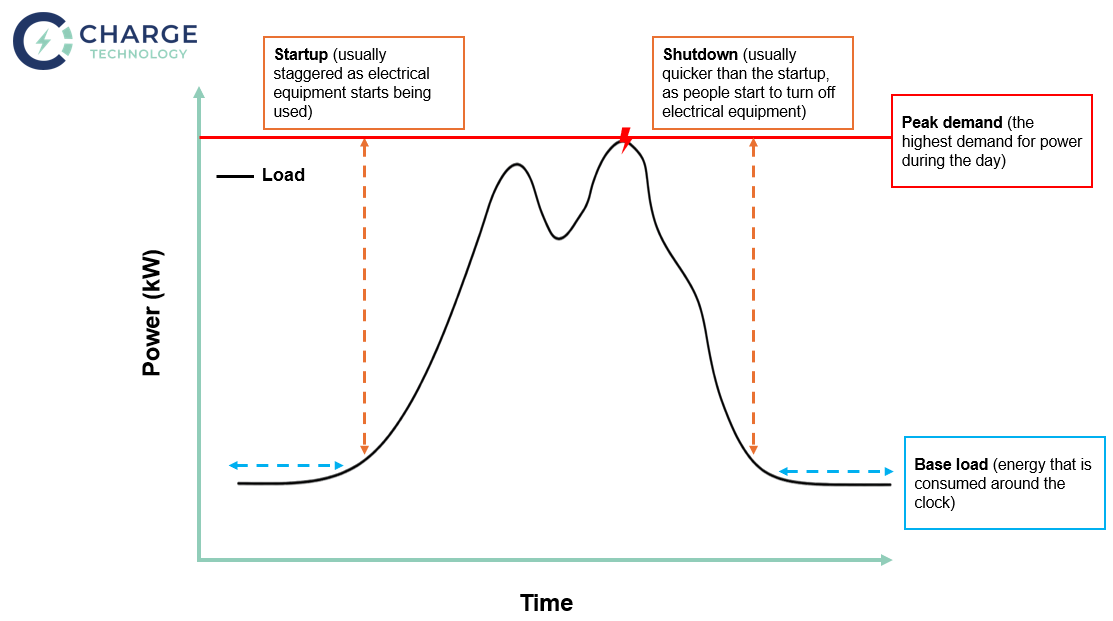
That maximum demand moment is the peak. It typically occurs on hot summer weekday afternoons, when commercial air conditioning, industrial production, and residential loads all converge simultaneously. During these periods, utilities must spin up expensive “peaker plants“, often gas turbines, that sit idle most of the year but are maintained solely to handle these brief demand spikes.
To recover the capital and operating costs of that infrastructure, utilities pass those costs on to large commercial and industrial (C&I) customers through demand charges: fees calculated based on a customer’s maximum power draw (measured in kilowatts, or kW) during a billing period, or sometimes during specific “peak demand windows” defined by the utility.
What Peak Shaving Actually Means
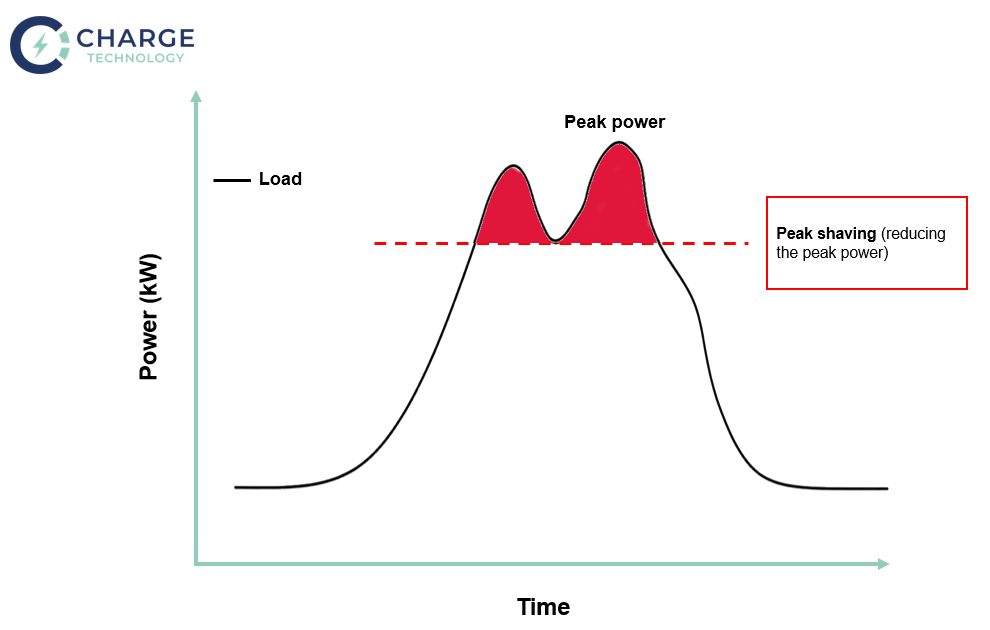
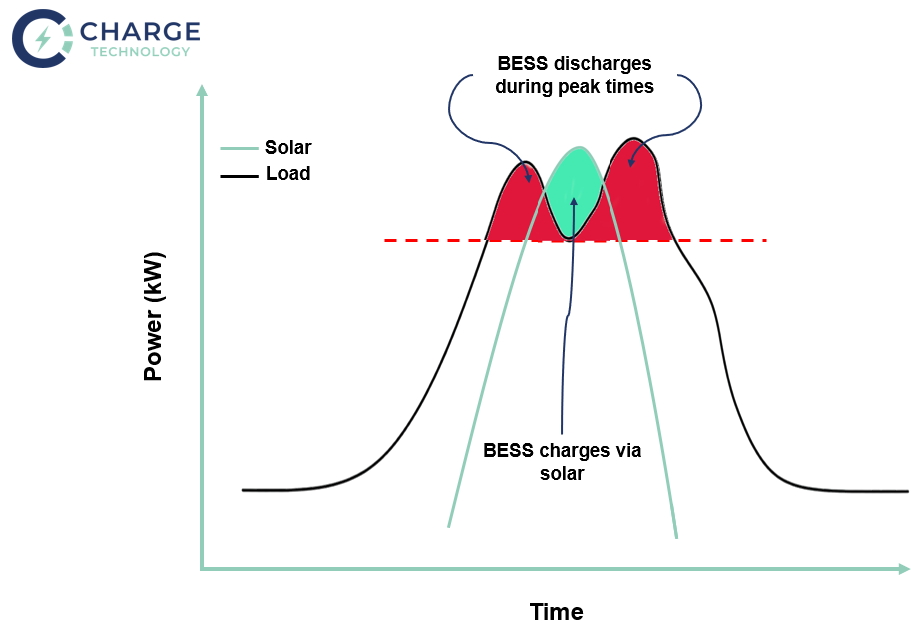
Peak shaving is the practice of reducing or “shaving off” the top of your facility’s power demand curve during these high-demand periods. The goal is to flatten the demand profile, to prevent or limit those spikes, so that your maximum demand (and therefore your demand charge) stays as low as possible.
The term is visual in nature. If you were to graph your facility’s power consumption over the course of a day, you’d see a rolling curve with valleys (nights, weekends, lulls in production) and peaks (startup surges, cooling loads on hot afternoons, heavy production runs). Peak shaving literally cuts the tops off those peaks, replacing them with a flatter line.
The result: lower maximum demand readings, lower demand charges, and a significant reduction in total electricity cost.
Why Commercial and Industrial Customers Are the Target
Residential electricity customers are rarely exposed to demand charges; their bills are almost entirely consumption-based. But utilities treat large C&I customers differently, and for good reason: a single large industrial facility or commercial campus can place as much demand on the grid as thousands of homes. The financial and operational stakes are correspondingly larger.
Common sectors where peak shaving delivers major value include:
- Manufacturing and heavy industry: Motor startups, compressors, and production cycles create sharp demand spikes
- Data centers: Cooling systems and server loads create sustained high-demand profiles with periodic spikes
- Cold storage and food processing: Refrigeration compressors create intense demand, especially during loading/unloading cycles
- Commercial real estate and mixed-use developments: Aggregated HVAC, elevator, and tenant loads create predictable daily peaks
- Healthcare facilities: Imaging equipment, surgical theaters, and 24/7 operations create complex demand profiles
- Municipalities and utilities: Water treatment plants, wastewater facilities, and public buildings all face demand charges
How Demand Charges Work (And Why They’re So Painful)
The Mechanics of Demand Charge Billing
Understanding peak shaving requires a clear grasp of how demand charges are structured. While specifics vary by utility and tariff, the basic model works like this:
Your facility’s electrical meter records power consumption (in kilowatts) at regular intervals, typically every 15 minutes, though some utilities use 30-minute or hourly intervals. At the end of the billing period, the utility identifies the single highest 15-minute average demand reading recorded during that period. That number, in kW, becomes your monthly billing demand.
Your demand charge is then calculated by multiplying the billing demand by a rate (expressed in $/kW/month) set by your utility tariff.
Example:
- A manufacturing facility’s highest 15-minute demand reading in July: 850 kW
- Utility demand charge rate: $18/kW/month
- Monthly demand charge: 850 × $18 = $15,300
Now suppose that an 850 kW spike happened just once, during a single 15-minute window when three large motors started simultaneously at shift change on a hot afternoon. For the rest of the month, the facility averaged 600 kW. But that one spike set the entire month’s demand charge at $15,300 instead of the $10,800 it would have been at 600 kW, a $4,500 difference because of 15 minutes of inattention.
Multiply that across 12 months, and you begin to see the stakes.
Time-of-Use and Ratchet Clauses
Many utilities add additional complexity and cost through two mechanisms:
Time-of-Use (TOU) Demand Charges: Rather than measuring peak demand across the entire billing period, TOU tariffs establish specific “peak demand windows” (often weekday afternoons from noon to 8 PM in summer) and charge a higher $/kW rate for the maximum demand recorded during those windows. This intensifies the incentive to manage demand precisely during those hours.
Ratchet Clauses: Some industrial tariffs include ratchet provisions that base your minimum billing demand on a percentage (often 80–90%) of your highest demand in the previous 11–12 months. In practice, this means a single demand spike can penalize you for a full year, not just one month. For facilities with ratchet clauses, peak shaving becomes even more financially urgent.
How Does Peak Shaving Work?
Peak shaving can be achieved through several mechanisms, which are often layered together for maximum effect. The most effective modern approaches combine battery energy storage systems (BESS) with intelligent energy management software and, sometimes, on-site generation.
Mechanism 1: Battery Energy Storage Systems (BESS)
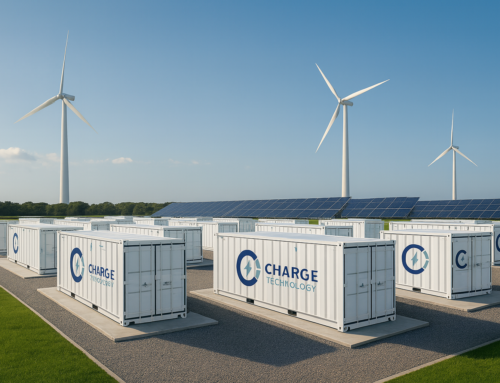
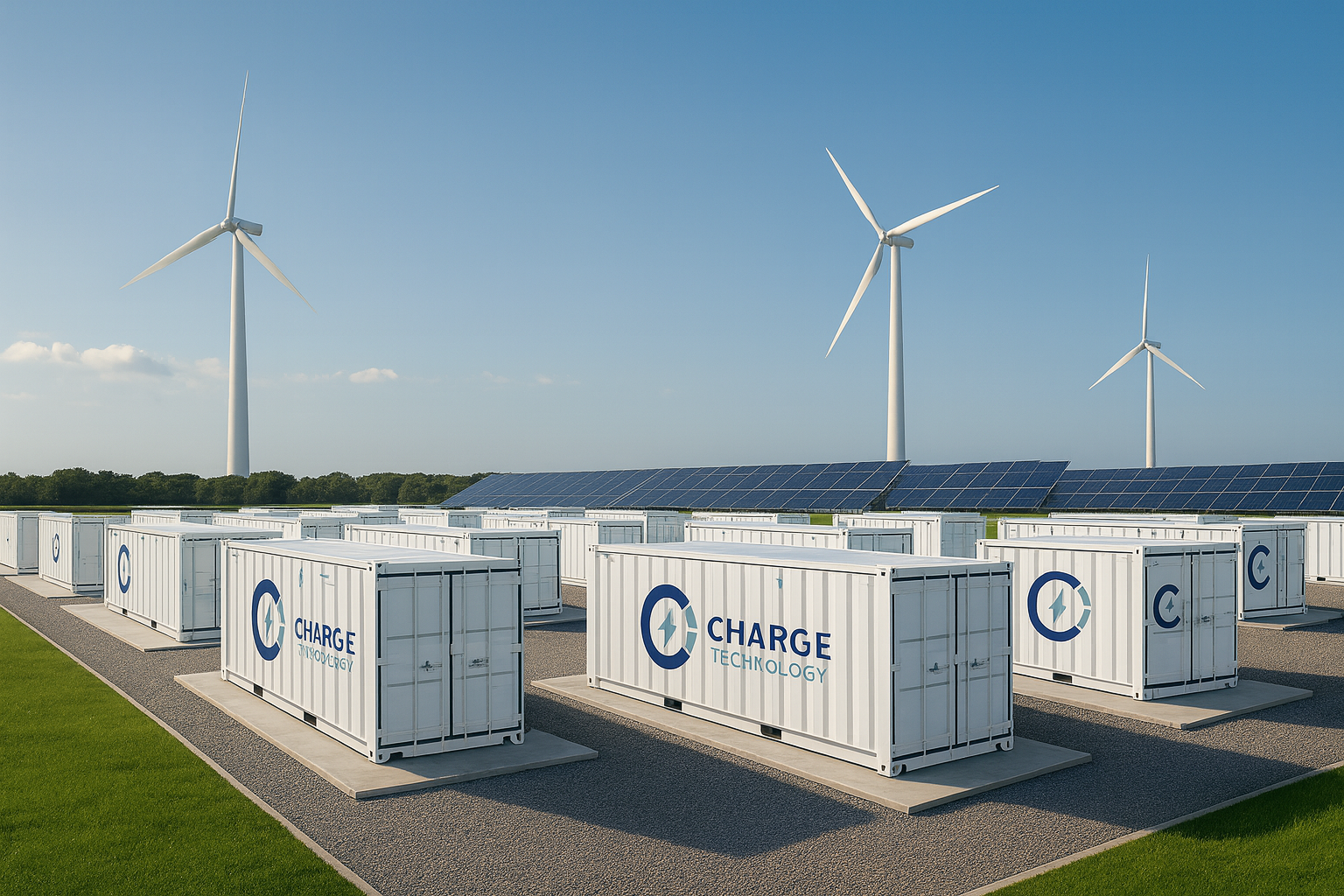
Battery energy storage is the most powerful and flexible tool for peak shaving in modern C&I applications. The fundamental principle is elegant: charge the battery when facility demand is low and grid power is cheap, then discharge it to supplement facility power during demand peaks, preventing spikes from reaching the utility meter.
How a BESS Peak Shaving System Works Step by Step:
- Baseline establishment: An energy management system (EMS) monitors the facility’s real-time power demand and establishes a demand setpoint. This maximum power draw should be allowed to reach the utility meter (for example, 700 kW).
- Continuous monitoring: The EMS watches the facility’s demand in real time, typically at sub-second resolution.
- Peak detection: When facility demand approaches the setpoint, say, it rises to 680 kW and is trending upward, the EMS dispatches the battery to begin discharging.
- Demand capping: As the facility’s actual demand rises to 850 kW, the battery is discharging at 150 kW, so the net demand seen by the utility meter remains at or below 700 kW. The peak is effectively “shaved.”
- Battery recharge: Once the demand event passes and facility load drops back below the setpoint, the EMS stops battery discharge and may begin recharging the battery at a low, controlled rate during off-peak hours, being careful not to create a new demand spike during recharging.
Practical Example, Cold Storage Facility:
A cold storage operator in the Midwest operates a large refrigerated warehouse, with monthly peak demand consistently reaching 1,100–1,200 kW during afternoon loading cycles, when multiple compressors run simultaneously. Their utility’s demand charge is $21/kW/month.
After installing a 500 kW / 1,000 kWh lithium-ion BESS with an integrated EMS, the system holds its demand setpoint at 900 kW. During compressor surges, the battery discharges to cover the difference—their new peak demand on the utility meter: 905 kW.
- Previous demand charge: 1,150 kW × $21 = $24,150/month
- New demand charge: 905 kW × $21 = $19,005/month
- Monthly savings: $5,145
- Annual savings: $61,740
With a BESS installed at approximately $400–$600/kWh (installed cost), a 1,000 kWh system might cost $500,000–$600,000. At $61,740/year in savings, the simple payback period is approximately 8–10 years, often improved significantly by available incentives and the system’s additional revenue streams.
Mechanism 2: Demand Response Programs
Many utilities and grid operators offer demand response (DR) programs that pay customers to voluntarily reduce their consumption during grid emergencies or extreme demand events. While technically distinct from peak shaving, demand response complements it well.
In a DR event, the utility sends a signal, sometimes with as little as 15 minutes’ notice, asking participating customers to shed load for a period (typically 1–4 hours). Customers who comply receive bill credits or direct payments. A BESS-equipped facility can fulfill these commitments automatically, discharging the battery to maintain operations while reducing grid draw, capturing both demand charge savings and DR revenue simultaneously.
Mechanism 3: On-Site Generation
Diesel generators, natural gas generators, combined heat and power (CHP) systems, and on-site solar can all contribute to peak shaving by supplementing grid power during high-demand periods. However, generators have limitations: they take time to start, produce emissions, require fuel management, and may be restricted in operating hours by air quality permits.
Solar photovoltaic (PV) is increasingly paired with BESS for peak shaving. Solar can shave daytime peaks by providing on-site generation during peak windows, but its output is variable. Pairing solar with a battery ensures that solar energy can be captured, stored, and dispatched precisely when it’s needed for demand management, not just when the sun is shining.
Practical Example, Commercial Office Campus:
A 500,000 sq. ft. office and retail campus in California installs a 1.2 MW rooftop solar array paired with a 600 kW / 2,400 kWh BESS. The solar charges the battery in the morning; the battery discharges during the utility’s peak demand window (2 PM–9 PM under the local TOU-GS-3 tariff). The combined system shaves 400 kW off their afternoon peak demand and earns SGIP (Self-Generation Incentive Program) rebates, dramatically improving project economics.
Mechanism 4: Operational Load Management
Sometimes, the most cost-effective peak shaving doesn’t require any capital investment; it requires operational discipline. Load management strategies include:
- Staggered startups: Preventing multiple large motors or HVAC units from starting simultaneously, spreading inrush currents across time
- Production scheduling: Shifting energy-intensive processes to off-peak hours (nights and weekends) where demand charge windows don’t apply
- HVAC pre-cooling: Running cooling systems harder during off-peak morning hours to “pre-cool” the building, allowing HVAC demand to be throttled back during afternoon peak windows
- Smart building automation: Using building energy management systems (BEMS) to automatically curtail non-critical loads (lighting, auxiliary equipment, EV charging) during peak windows
For many facilities, a combination of operational changes and a modestly sized BESS can achieve better economics than a BESS alone.
Peak Shaving vs. Load Shifting
These two terms are often used interchangeably, but they describe related yet distinct strategies. Understanding the difference is essential for designing an effective energy management program.
What Is Load Shifting?
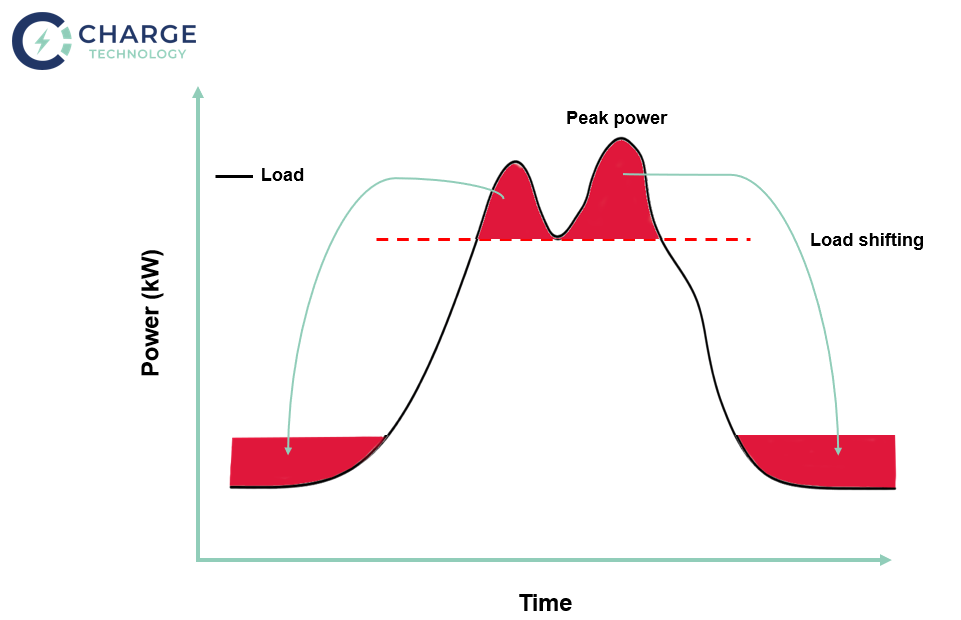
Load shifting is the practice of moving energy consumption from one time period to another, specifically, from high-cost or high-demand periods to low-cost or low-demand periods. The total amount of energy consumed over a day or billing period may remain the same; what changes is when it’s consumed.
Load shifting is primarily an energy cost arbitrage strategy. It takes advantage of time-of-use (TOU) energy rates, where the per-kWh cost of electricity varies by time of day: expensive during peak hours, cheap during off-peak hours (typically nights and weekends).
Example of Load Shifting: A food processing plant uses a large chiller system. Instead of running the chiller at full capacity throughout the day (including the expensive 2 PM–8 PM TOU peak window), the operator runs it aggressively from midnight to 6 AM at the cheap off-peak rate to build up a “thermal bank” of chilled water or ice. During the afternoon peak window, the plant draws on that stored cooling capacity rather than running the chiller at full power. The total cooling energy used is the same; the cost drops because most of it was purchased at off-peak rates.
How Peak Shaving and Load Shifting Differ
| Dimension | Peak Shaving | Load Shifting |
|---|---|---|
| Primary goal | Reduce demand (kW) peaks | Reduce energy (kWh) costs |
| Metric targeted | Demand charges ($/kW) | Energy charges ($/kWh) |
| Mechanism | Flatten demand curve at peak moments | Move consumption to cheaper time periods |
| Duration | Brief discharge events (minutes to ~2 hours) | Sustained period-to-period shifting (hours) |
| Primary savings driver | Avoiding demand charge spikes | Exploiting TOU rate differentials |
| Storage needed? | Yes, for BESS-based approaches | Often yes (thermal or battery storage) |
| Reduces total energy used? | Not necessarily | No |
How They Work Together
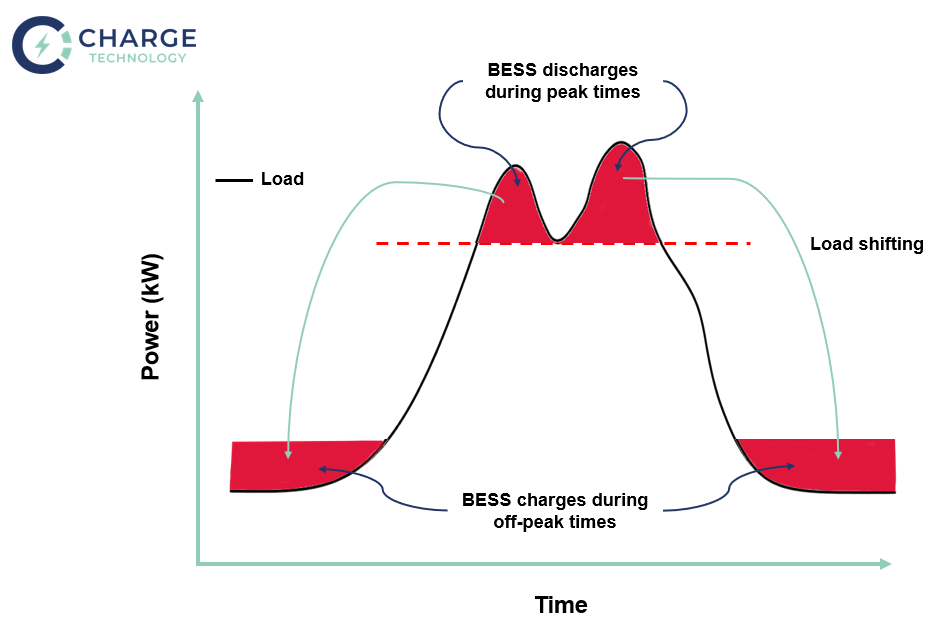
In practice, the most effective energy management strategies combine both. A BESS programmed with a sophisticated EMS can simultaneously:
- Shave demand peaks: by capping discharge at the demand setpoint during high-load events
- Shift energy loads: by charging the battery at cheap off-peak rates and discharging during expensive TOU windows
This dual-mode operation, sometimes called peak shaving with energy arbitrage, is the standard programming approach for C&I BESS installations and dramatically improves project economics compared to optimizing for either strategy alone.
shining.
Practical Example, Data Center:
A 10 MW colocation data center in Texas operates on an electric tariff with both demand charges ($15/kW/month) and aggressive TOU energy pricing ($0.18/kWh peak vs. $0.06/kWh off-peak). They install a 2 MW / 8 MWh BESS:
- Peak shaving function: During demand events, the battery discharges to hold metered demand below 8.5 MW, avoiding spikes that would otherwise push billing demand to 10+ MW
- Load shifting function: The battery charges every night between 11 PM and 5 AM at $0.06/kWh and discharges during peak pricing windows at $0.18/kWh, capturing $0.12/kWh in energy cost arbitrage
Combined annual savings: demand charges reduced by ~$250,000, energy arbitrage adds ~$180,000—total $430,000/year, dramatically improving the project’s business case.
Sizing a Peak Shaving Battery System
Proper sizing requires careful analysis of your load profile. The key variables are:
Power rating (kW): The maximum rate at which the battery can discharge. This must be large enough to cover the difference between your current demand peaks and your target demand setpoint. If your peaks reach 1,000 kW and you want to hold demand at 750 kW, you need a battery with at least 250 kW of discharge capacity, ideally with margin.
Energy capacity (kWh): The total energy the battery can deliver before it needs to recharge. This depends on how long your demand peaks typically last. A 250 kW battery needs to cover a 2-hour peak event? That requires 500 kWh of usable capacity.
Depth of discharge (DoD): Most lithium batteries shouldn’t be fully depleted, typical usable DoD is 80–90%. A 500 kWh battery might have 550–625 kWh of nameplate capacity to yield 500 kWh useably.
Recharge time and strategy: The EMS must recharge the battery during off-peak periods without creating a new demand spike. A controlled, slow recharge rate (typically 0.25 C-rate or less) spread over several hours is standard.
A qualified energy storage integrator will typically perform a detailed load profile analysis—pulling 12–24 months of 15-minute interval meter data—to model optimal system sizing and project economics before recommending a configuration.
The Role of Energy Management Software
The battery hardware is only part of the equation. The intelligence that makes peak shaving work lives in the energy management system (EMS). Modern EMS platforms use:
- Real-time demand monitoring at sub-second intervals
- Predictive algorithms that anticipate demand events based on weather forecasts, production schedules, and historical patterns
- Machine learning to continuously optimize dispatch decisions
- Multi-objective optimization that simultaneously manages demand charges, TOU energy costs, demand response commitments, and battery state-of-health
Financial Analysis and Incentives
Building the Business Case
A peak shaving project’s financial case rests on several value streams:
- Demand charge reduction: Often the primary driver in C&I applications
- TOU energy arbitrage: Secondary but significant in markets with high rate spreads
- Demand response revenue: Utility and grid operator DR programs can add $50,000–$200,000+ annually for larger systems
- Capacity market payments: In wholesale markets like PJM or NYISO, behind-the-meter storage can participate in capacity markets with the right contractual structure
- Resiliency value: Backup power capability reduces the financial risk of outages (often valued at $50,000–$500,000/event for critical facilities)
- Carbon and sustainability value: BESS can facilitate on-site solar integration, support ESG reporting, and help meet corporate carbon targets
Key Incentives and Programs
Federal Investment Tax Credit (ITC): As of current law under the Inflation Reduction Act, standalone BESS systems (not paired with solar) qualify for the ITC, with bonus adders available for domestic content (BABA-Compliant Energy Storage Systems), energy communities, and low-income projects. This is a transformative incentive that can reduce installed project cost by 30% or more.
MACRS Accelerated Depreciation: Energy storage systems qualify for 5-year MACRS depreciation and, in many cases, bonus depreciation, providing significant tax benefits that improve after-tax project returns.
State and Utility Incentives: Programs like California’s SGIP (up to $400/kWh for commercial storage), New York’s Con Edison BESS incentive, Massachusetts SMART program, and various utility-specific rebates can substantially improve project economics.
Utility Demand Response Programs: Many utilities offer direct financial incentives for commercial customers who commit to demand response participation, essentially paying customers to be “interruptible.” A well-sited BESS can capture these payments with minimal operational disruption.
Implementation of Peak Shaving for C&I Facilities
Step 1: Audit Your Current Demand Profile
Pull 12–24 months of 15-minute interval meter data from your utility. Map your demand peaks: when do they occur? How often? How high? What activities drive them? This data is the foundation of every subsequent decision.
Step 2: Review Your Utility Tariff
Understand exactly how your demand charges are structured: the $/kW rate, the measurement interval, any ratchet clauses, TOU windows, and demand response program availability. Your tariff determines which strategies will deliver the most value.
Step 3: Identify Operational Quick Wins
Before investing in hardware, identify free or low-cost operational changes, staggered startups, scheduling adjustments, and HVAC pre-cooling that can reduce peaks without capital expenditure.
Step 4: Model Your BESS Sizing Options
Work with an energy storage integrator or independent energy consultant to model system sizing scenarios and project economics. A good model will include sensitivity analysis around future electricity rates, battery degradation, and potential incentive changes.
Step 5: Evaluate Interconnection and Permitting Requirements
BESS installations require utility interconnection approval, electrical permits, building permits, and, in some jurisdictions, fire department approval. Lead times vary widely by utility, from weeks to over a year in congested areas. Begin this process early.
Step 6: Secure Financing
Depending on your organization’s tax position and capital preferences, BESS projects can be financed through:
- Direct purchase (best if you have a tax appetite for ITC and MACRS)
- Tax equity structures: If you lack sufficient tax liability, a tax equity partner can monetize the ITC
- Lease or PPA structures: Third-party ownership models where you pay for energy services rather than owning hardware
- Green bonds or sustainability-linked debt: Increasingly common for large-scale corporate energy projects
Step 7: Commission, Monitor, and Optimize
Once installed, continuous monitoring and periodic reoptimization of EMS setpoints ensure the system continues to deliver maximum value as load profiles, tariff structures, and market conditions evolve.
Closing Thoughts: Peak Shaving as a Strategic Imperative
Peak shaving is no longer a niche technique reserved for the most sophisticated industrial energy managers. As demand charges escalate, TOU rate structures become more prevalent, battery costs continue to fall, and federal incentives reach unprecedented levels, peak shaving with battery energy storage is becoming a mainstream strategy across the commercial and industrial landscape.
The companies and developers who understand this shift and proactively implement demand management strategies will enjoy structural cost advantages over competitors who continue to pay full demand charges without question. More broadly, reducing demand peaks delivers real benefits to the broader grid: deferred infrastructure investment, reduced reliance on carbon-intensive peaker plants, and a more flexible, resilient electricity system for everyone.
Whether you’re a facility manager looking to control utility costs, a developer evaluating energy storage for a new project, or a corporate sustainability officer looking for concrete ways to reduce your carbon footprint and energy spend, peak shaving deserves a prominent place in your energy strategy.
The peak has always been there. The question is whether you’re going to pay for it or shave it.