A practical deep-dive into kW vs kWh
If you’ve ever watched a client’s eyes glaze over when you explain why a 100 kWh battery system with a 15 kW inverter can’t fast-charge an electric vehicle, or sat through a procurement meeting where someone confused “power capacity” with “energy capacity”, you already know why the distinction between kilowatts and kilowatt-hours matters.
kW and kWh are not interchangeable. They’re not even the same type of thing. Conflating them is the equivalent of confusing how fast a car can go with how far it can travel on a full tank. And in the world of battery energy storage systems (BESS) and EV charging infrastructure, getting this wrong doesn’t just lead to an awkward conversation; it results in undersized systems, stranded assets, and cost overruns.
This article is not a beginner’s guide. It’s a practitioner’s reference, the kind of clarity you need when you’re sizing a BESS for a C&I customer, specifying EV charging equipment for a fleet depot, or explaining to a building owner why the system they have been quoted for won’t do what they need it to do.
The Difference Between kW vs. kWh
What is a kW?
kW (kilowatt) is a unit of power: the rate at which energy is transferred or consumed at any given instant. It answers the question: How fast is energy flowing right now?
The higher the kW of a device, the more power is needed to operate it. A kilowatt is 1000 watts (W).
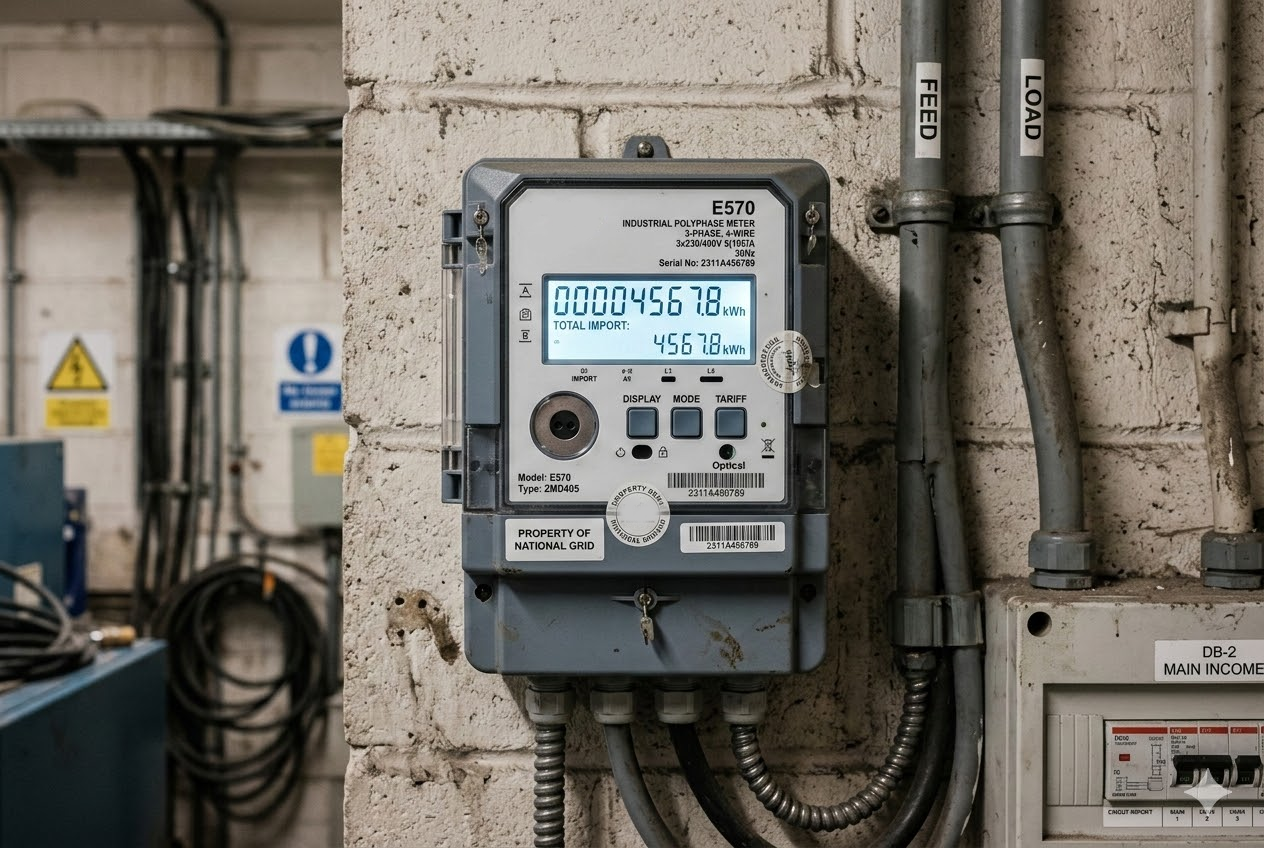
What is a kWh?
The relationship is simple:
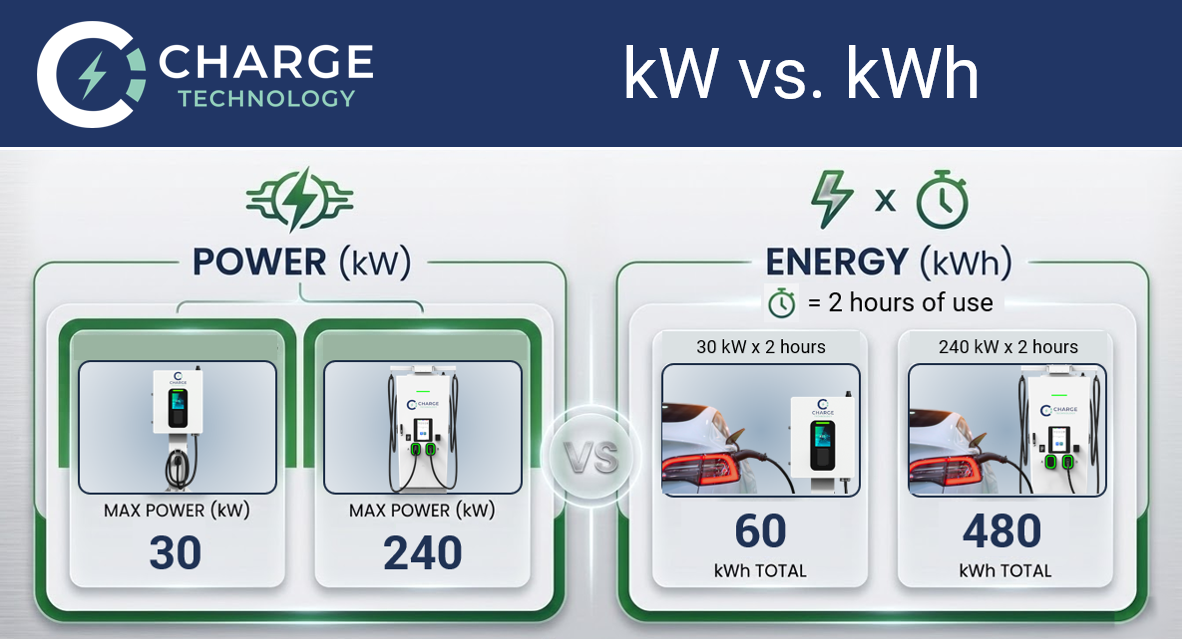
Energy (kWh) = Power (kW) × Time (hours)
Or, rearranged:
Power (kW) = Energy (kWh) ÷ Time (hours)
A 50 kW system running for 2 hours delivers 100 kWh. A 100 kW system running for 1 hour also delivers 100 kWh. Same energy, very different power profiles, and in real-world applications, that difference is everything.
Kilowatts and Kilowatt-Hours in Energy Storage
Sizing a BESS: Two Numbers, Two Different Questions
Every battery energy storage system has two critical specifications that are often cited together but describe completely different capabilities:
Energy capacity (kWh): How much electricity the battery can store in total — its “tank size.”
Power rating (kW): How quickly the battery can charge or discharge that stored energy — its “pipe size.”
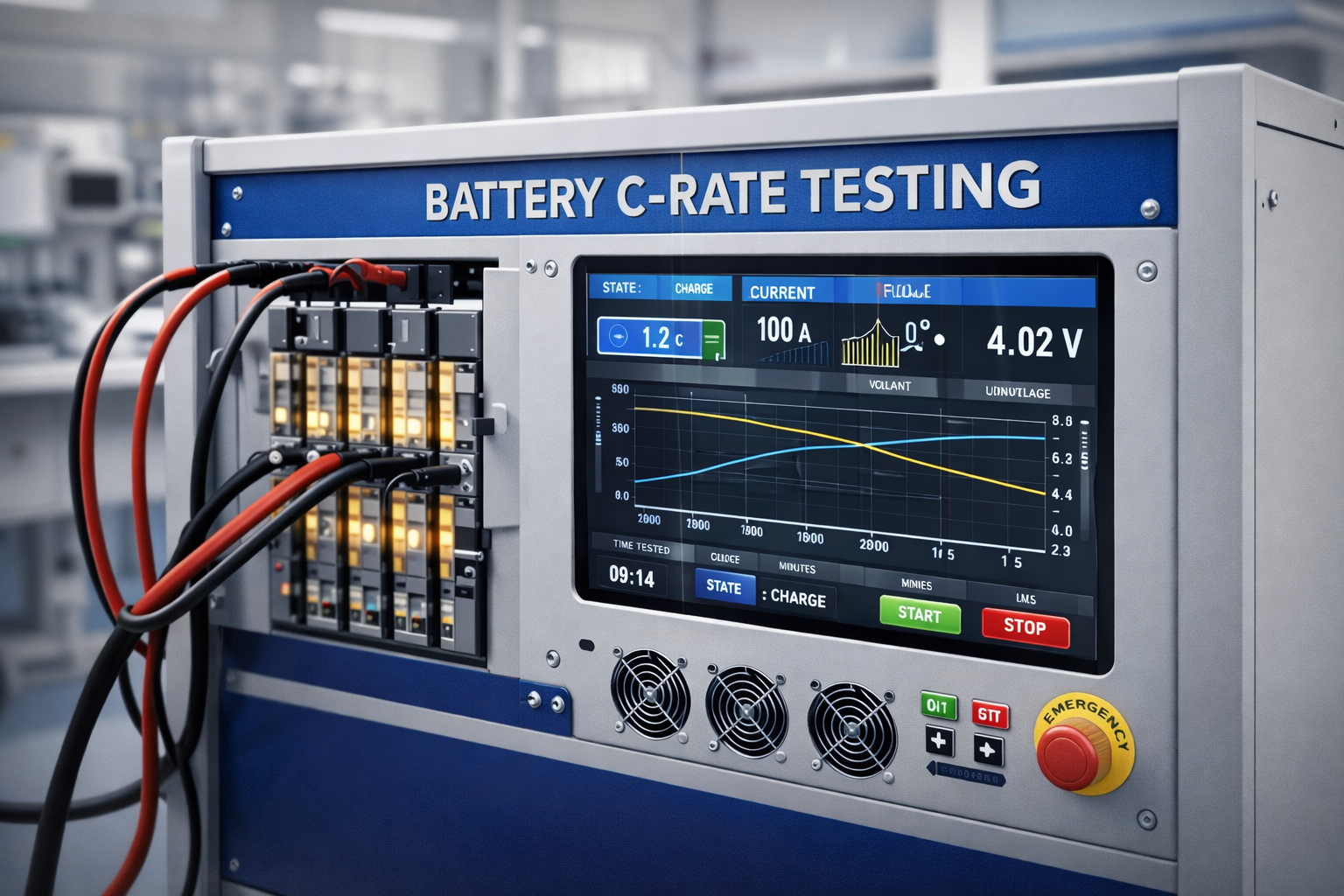
A 500 kWh / 250 kW BESS can store 500 kWh of energy, but can only push or pull electricity at a maximum rate of 250 kW at any moment. To fully discharge, it would take at least 2 hours (500 kWh ÷ 250 kW = 2 hours). This ratio — energy capacity divided by power rating — is known as the C-rate or duration, and it’s one of the most important parameters in energy storage system design.
Practical Example: C&I Peak Shaving:
A manufacturing facility has a 30-minute peak demand window during which it draws 800 kW. The utility applies a demand charge based on the highest 15-minute average, currently hitting $18/kW/month. The facility wants to use a BESS to shave that peak.
To shave 200 kW for 30 minutes, you need:
- Power: 200 kW (continuous discharge capability)
- Energy: 200 kW × 0.5 hours = 100 kWh
A system rated at 100 kWh / 50 kW is completely inadequate here; it cannot physically deliver 200 kW, regardless of how much energy is stored. Conversely, a 500 kWh / 200 kW system has more than enough power but is significantly over-built on energy capacity, adding unnecessary cost.
The lesson: when specifying a BESS, power and energy requirements must be calculated independently, then matched to a system that satisfies both.
The C-Rate: Where kW and kWh Meet
The C-rate (short for charge/discharge rate) ties power and energy together into a single dimensionless number:
C-rate = Power (kW) ÷ Energy Capacity (kWh)
A system discharging at a 1C rate will be fully depleted in 1 hour. A 0.5C rate means a 2-hour discharge. A 2C rate means 30 minutes.
| C-Rate | Discharge Duration | Typical Application |
|---|---|---|
| 0.25C | 4 hours | Utility-scale arbitrage, overnight load shifting |
| 0.5C | 2 hours | C&I peak shaving, solar self-consumption |
| 1C | 1 hour | Frequency regulation, grid ancillary services |
| 2C | 30 mins | Fast-response applications, EV fast charging buffer |
Most lithium-ion chemistries can comfortably operate at 0.5C to 1C continuously. Sustained discharge above 1C generates significant heat, accelerates degradation, and may require active thermal management. This is why a battery with a 200 kWh capacity paired with a 400 kW inverter (2C) is not simply “twice as powerful as a 200 kW system”; it may be operating outside the battery’s optimal range.
Depth of Discharge and Usable vs. Nameplate Capacity
Here’s something that often catches buyers and specifiers off guard: the nameplate kWh capacity is rarely the usable kWh capacity.
Most battery management systems (BMS) restrict the state of charge (SoC) to a window — say, for example, 10% to 90% — to preserve cycle life. That means a 500 kWh system might only deliver 400 kWh in practice (80% depth of discharge). When comparing systems, always ask for usable energy capacity, not nameplate.
Practical Example, Behind-the-Meter Solar + Storage:
A warehouse installs a 250 kW solar array paired with a battery system quoted as “200 kWh.” The goal is to maximise self-consumption and avoid grid imports during evening peak hours (17:00–21:00).
If the BMS limits DoD to 20%–90%, usable capacity is:
- 200 kWh × 70% = 140 kWh usable
Evening load averages 60 kW. Duration of storage support:
- 140 kWh ÷ 60 kW = ~2.3 hours
The system falls short of covering the full 4-hour peak window by nearly 2 hours. The specifier needs to either increase energy capacity to ~350 kWh nameplate (to achieve ~245 kWh usable) or accept partial peak coverage. A detail that matters significantly and is only visible when you account for the kWh vs. usable kWh distinction.
kW vs kWh in EV Charging
kW vs kWh is an entirely different conversation when it comes to EV charging. EV charging has its own vocabulary for power and energy, and the confusion between kW and kWh plays out in two distinct contexts: charger capability and vehicle capability.
What the Charger Rating Tells You
EV charger ratings are always in kW, a measure of power. This tells you how quickly the charger can deliver energy to a vehicle.
| Charger Type | Power Rating | Approx. Charge Rate |
|---|---|---|
| Level 2 | 7 kW | ~40–50 km of range per hour |
| Level 2 | 11 kW | ~65–75 km of range per hour |
| Level 2 | 22 kW | ~130–150 km of range per hour |
| DC Fast Charger | 60 kW | ~330–360 km of range per hour |
| DC Fast Charger | 120 kW | ~650–720 km of range per hour |
| DC Fast Charger | 180 kW | ~1000–1080 km of range per hour |
| DC Fast Charger | 400 kW | ~2200–24000 km of range per hour |
The charger’s kW rating alone, however, does not tell you how long it takes to charge a specific vehicle; for that, you need the vehicle’s battery capacity in kWh and its maximum charge acceptance rate in kW.
What the Vehicle Specification Tells You
Every EV has two relevant specs:
Battery capacity (kWh): The size of the tank, how much energy it can store.
and
Maximum charge rate (kW): The maximum rate at which the vehicle’s onboard charger (for AC) or the battery management system (for DC) will accept power.
A vehicle with a 70 kWh battery and an 11 kW AC onboard charger:
- On a 7 kW Level 2 charger: charges at 7 kW → full charge in ~10 hours
- On an 11 kW Level 2 charger: charges at 11 kW → full charge in ~6.4 hours
- On a 60 kW DC fast charger: still limited to what the car accepts, which varies by SoC and thermal state, but could be up to 60+ kW for certain vehicles
The critical point: installing a more powerful charger than the vehicle can accept delivers zero additional benefit for that vehicle. A 350 kW ultra-rapid charger does nothing extra for a vehicle that maxes out at 150 kW DC. The charger rating is a ceiling, not a floor.
kW’s and kWh’s in Fleet Charging: The Power-Energy Tension in Practice
Fleet charging scenarios are where the kW vs kWh distinction becomes strategically critical and where most planning errors occur.
Practical Example, Last-Mile Delivery Fleet:
A logistics operator runs 40 electric vans. Each van has:
- Battery capacity: 75 kWh
- Daily energy consumption: 45 kWh (based on route data)
- Charging window: 22:00–06:00 (8 hours overnight)
Energy requirement:
- Total energy per night: 40 vans × 45 kWh = 1,800 kWh
Power requirement (minimum):
- To deliver 45 kWh to each van in 8 hours: 45 kWh ÷ 8h = 5.625 kW per van
- A modest Level 2 charger is sufficient
- Total simultaneous load (if all charge at once): 40 × 5.625 kW = 225 kW
Now, compare this to a scenario where the operator wants all vans topped up within 2 hours (perhaps to handle a mid-day re-deployment):
- 45 kWh ÷ 2h = 22.5 kW per van
- Total simultaneous load: 40 × 22.5 kW = 900 kW
The energy demand hasn’t changed, still 1,800 kWh per cycle, but the power demand has quadrupled from 225 kW to 900 kW. This has massive implications for:
- Grid connection size and upgrade costs
- Transformer capacity
- Demand charges on the electricity bill
- Whether a BESS is required to buffer peak draw
This is the fundamental tension in fleet electrification: energy needs determine infrastructure capacity, but power needs determine infrastructure cost. Getting the timing wrong and defaulting to “fastest possible charging” when overnight slow charging would suffice is how operators spend hundreds of thousands of pounds they didn’t need to spend.
Managed Charging and Smart Load Shaping
Understanding kW vs kWh directly enables the logic behind managed charging (also called smart charging or dynamic load management). The core idea: you have a fixed energy requirement (kWh) and some flexibility in when and how fast that energy is delivered. By varying the power rate (kW) delivered to each vehicle over the available time window, you can flatten the power demand curve and avoid peak loads.
Example:
A car park has 20 charging bays on a shared 100 kW electrical supply. At 17:30, 18 vehicles arrive simultaneously, each needing 30 kWh. If all start charging at maximum (7.7 kW per vehicle), the instantaneous load is:
18 × 7.7 kW = 138.6 kW — exceeding the 100 kW supply
A managed charging system distributes the available 100 kW across connected vehicles:
100 kW ÷ 18 vehicles = ~5.6 kW each
At 5.6 kW, 30 kWh takes: 30 ÷ 5.6 = ~5.4 hours — comfortably within an overnight window.
The total energy delivered is the same. The peak power demand stays within the available supply. Without understanding the kW/kWh relationship, this logic is opaque. With it, it’s straightforward.
Why kW Is the Expensive Number: Grid Connection and Demand Charges
If there’s one place where confusing kW and kWh costs real money, it’s in grid tariff structures.
Most commercial and industrial electricity tariffs have two components:
Consumption charges (p/kWh): You pay for every unit of energy you use.
Demand charges (£/kW/month): You pay based on your peak power demand, typically measured as the highest 15 or 30-minute average demand recorded in the billing period.
Demand charges can represent 30–70% of a C&I customer’s electricity bill. The key insight: demand charges are triggered by kW, not kWh. A facility that draws 500 kW for 15 minutes pays the same demand charge as one that draws 500 kW for 8 hours, even though the second facility consumed 32× more energy.
This is the commercial logic underpinning peak-shaving BESS deployments. By discharging a battery at critical demand peaks, you reduce the recorded kW maximum, cutting the demand charge, regardless of how much total energy (kWh) is consumed over the month.
Practical Example, Demand Charge Reduction:
A food processing facility in the UK has a monthly peak demand of 1,200 kW. The demand charge rate is £15/kW/month.
- Monthly demand charge: 1,200 kW × £15 = £18,000/month
A BESS is installed to clip peaks above 900 kW. The system dispatches 300 kW during daily peak windows (averaging 45 minutes per day). Energy dispatched per month:
- 300 kW × 0.75h × 22 working days = 4,950 kWh/month
If the BESS was charged at off-peak rates (say, 8p/kWh) and discharges at a time that avoids 900+ kW peaks:
- New monthly demand charge: 900 kW × £15 = £13,500
- Saving: £4,500/month
- BESS charging cost: 4,950 kWh × £0.08 = £396/month
- Net monthly benefit: ~£4,100/month
The kWh figure tells you how much the battery cycles. The kW figure tells you what the battery actually earns. Both matter, but for different reasons.
Common Misconceptions Between kW’s and kWh’s — And How to Address Them
“A bigger battery means faster charging”
No. A larger kWh battery can store more energy, but it cannot necessarily deliver that energy faster. A 200 kWh battery with a 50 kW inverter charges or discharges no faster than a 100 kWh battery with the same inverter, it just runs for longer. Speed is determined by the power rating (kW) of the inverter and power electronics, not the battery capacity.
“My EV has a 100 kW charger, so it takes 1 hour to charge”
This requires knowing the battery capacity (kWh). A 100 kWh battery on a 100 kW charger takes approximately 1 hour, but the vehicle also has to accept 100 kW throughout, which most vehicles do not sustain at high SoC. Real-world charging curves taper significantly above 80% SoC.
“We need X kWh of storage to support X kW of load”
This conflates energy and power again. Supporting a 500 kW load requires a battery capable of 500 kW discharge power. How long that support lasts depends on energy capacity. A 100 kWh / 500 kW battery (0.2 hour duration) supports 500 kW for just 12 minutes. A 2,000 kWh / 500 kW battery supports it for 4 hours. Same load, very different system.
“kWh is the important one for EV charging”
Both matter, but in different ways. kWh tells you how much range you’ll add to the vehicle. kW tells you how fast you’ll add it. A driver wanting to add 50 kWh of charge (roughly 250–300 km of range) can do so in 1 hour at 50 kW, or in 10 minutes at 300 kW. The outcome in kWh is identical; the experience is completely different.
Closing Thoughts
The kW vs kWh distinction is foundational, not because it’s complex, but because it’s consequential. In energy storage, it’s the difference between a system that clips peaks and one that runs out of energy before the peak is over. In EV charging, it’s the difference between a depot that has all vehicles ready at 06:00 and one that’s scrambling because the chargers were under-specified on power.
For professionals working in these sectors, fluency in both dimensions isn’t just technical accuracy, it’s commercial competence. Projects are won or lost, systems succeed or fail, and customer relationships are built or broken on the quality of these calculations.
kWh answers: How much? kW answers: How fast?
Any system that doesn’t satisfy both questions for the application in question is the wrong system, regardless of how impressive either number looks in isolation.