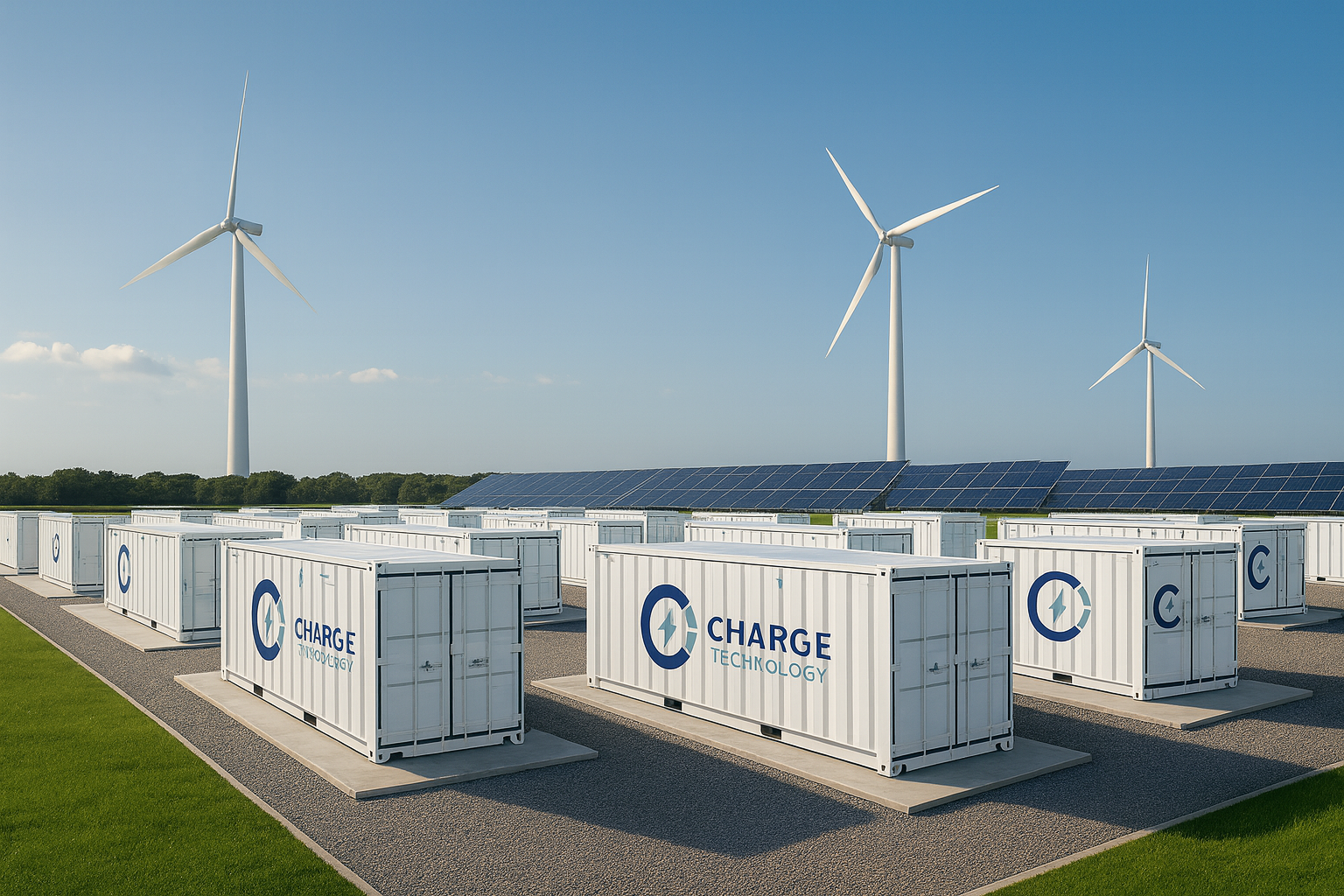
The Complete Guide to Battery Energy Storage & How it Works
The global energy landscape is undergoing one of the most significant transformations in modern history. Renewable generation is scaling at a record pace, electricity grids are under mounting pressure, and energy costs are climbing with new volatility. In this environment, battery energy storage systems (BESS) have moved from niche technology to critical infrastructure, and understanding how they work is no longer optional for the companies and developers shaping tomorrow’s built environment.
Whether you manage a manufacturing facility with a punishing demand charge profile, develop utility-scale solar projects, or oversee a commercial real estate portfolio looking to reduce grid dependency, this guide gives you a thorough, practical grounding in battery energy storage: what it is, how it works, the technologies available, and how it creates real value across commercial and industrial applications.
What Is a Battery Energy Storage System (BESS)?
A battery energy storage system is a technology platform that captures electrical energy, stores it electrochemically, and releases it on demand. At its most fundamental level, a BESS charges when electricity is abundant or cheap, and discharges when electricity is needed, expensive, or unavailable.
The term “battery energy storage system” refers not just to the battery cells themselves, but to the complete integrated system that includes:
- Battery modules: the electrochemical cells that store energy
- Battery Management System (BMS): software and hardware that monitor and protect each cell
- Energy Management System (EMS): the intelligence layer that determines when to charge and discharge
- Thermal Management System: keeps cells within safe and optimal temperature ranges
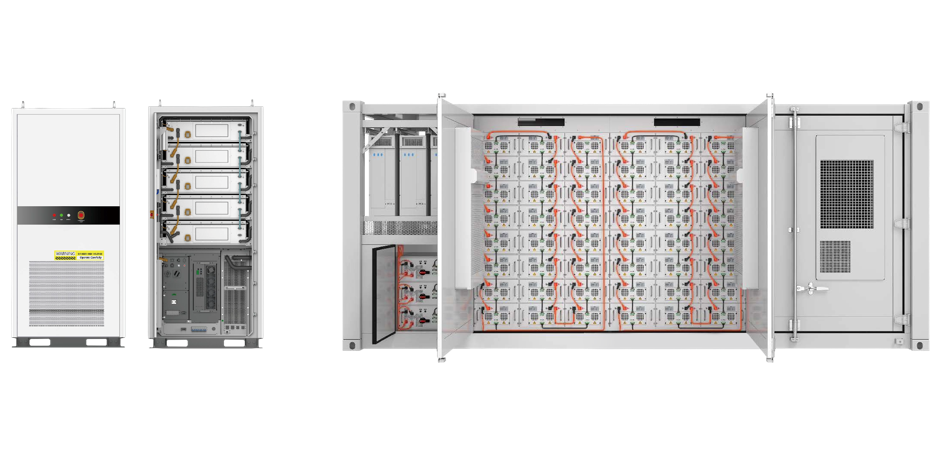
- Enclosure and structural components: containers, racks, fire suppression, and safety systems
- Power Conversion System (PCS) / Inverter: all-in-one battery energy storage systems come with a PCS/inverter, which converts between AC and DC electricity
Think of a BESS less like a single battery and more like a sophisticated power plant, one that can respond in milliseconds, operate autonomously, and integrate with everything from solar arrays to national grid infrastructure.
How Battery Energy Storage Works
To understand BESS more deeply, it helps to look at what’s happening at the cellular level. A battery cell stores energy through electrochemical reactions, the conversion of chemical energy into electrical energy and back again.
The Core Components of a Battery Cell
Every rechargeable battery cell contains:
- An anode (negative electrode): typically graphite in lithium-ion chemistries
- A cathode (positive electrode): the chemistry here largely defines battery type (e.g., lithium iron phosphate, nickel manganese cobalt)
- An electrolyte: the medium (liquid, gel, or solid) through which ions travel between electrodes
- A separator: a porous membrane that prevents the anode and cathode from physically touching while allowing ion flow
Charging: Storing Energy
When you charge a lithium-ion battery, an external voltage forces lithium ions to migrate from the cathode, through the electrolyte, and intercalate (insert themselves) into the layered structure of the graphite anode. Simultaneously, electrons flow through the external circuit — your charging cable — in the same direction. The anode becomes lithium-rich, storing potential energy in this new chemical configuration.
Discharging: Releasing Energy
When the battery discharges, the process reverses spontaneously. Lithium ions migrate back from the anode to the cathode through the electrolyte, while electrons flow through the external circuit in the opposite direction, producing the electric current that powers your load. This electron flow is the electricity you use.
The elegance of this chemistry is its reversibility: a well-managed lithium-ion cell can perform this cycle thousands of times before significant capacity degradation occurs.
Key Battery Energy Storage System Metrics
Before evaluating any BESS, you need to speak the language. Here are the metrics that determine whether a system fits your application.
Energy Capacity (MWh or kWh)
The total amount of energy a system can store and deliver. A 1 MWh system can theoretically deliver 1,000 kW for one hour, or 500 kW for two hours.
Power Rating (MW or kW)
The maximum rate at which the system can charge or discharge at any given moment. This is separate from capacity; a system can have high power but low energy (a sprinter) or high energy but lower power (a marathon runner).
Learn more about the difference between kilowatt and kilowatt-hour.
Duration
The ratio of energy to power. A 2 MWh system with a 1 MW inverter has a 2-hour duration. Duration requirements are a primary driver of system design and cost.
Round-Trip Efficiency (RTE)
The percentage of energy recovered for every unit stored. Modern lithium-ion systems typically achieve 85–95% round-trip efficiency. If you put in 1 MWh, you get back 0.85–0.95 MWh.
Depth of Discharge (DoD)
The percentage of total capacity that can be used without degrading battery life. Operating a battery between 10% and 90% state of charge (an 80% DoD) is a common design choice that extends cycle life.
Cycle Life
The number of full charge/discharge cycles a battery can complete before reaching a defined end-of-life capacity (typically 80% of its original capacity). This is crucial for economic modeling — a system rated for 4,000 cycles at 80% DoD will behave very differently over its lifetime than one rated for 1,500 cycles.
C-Rate
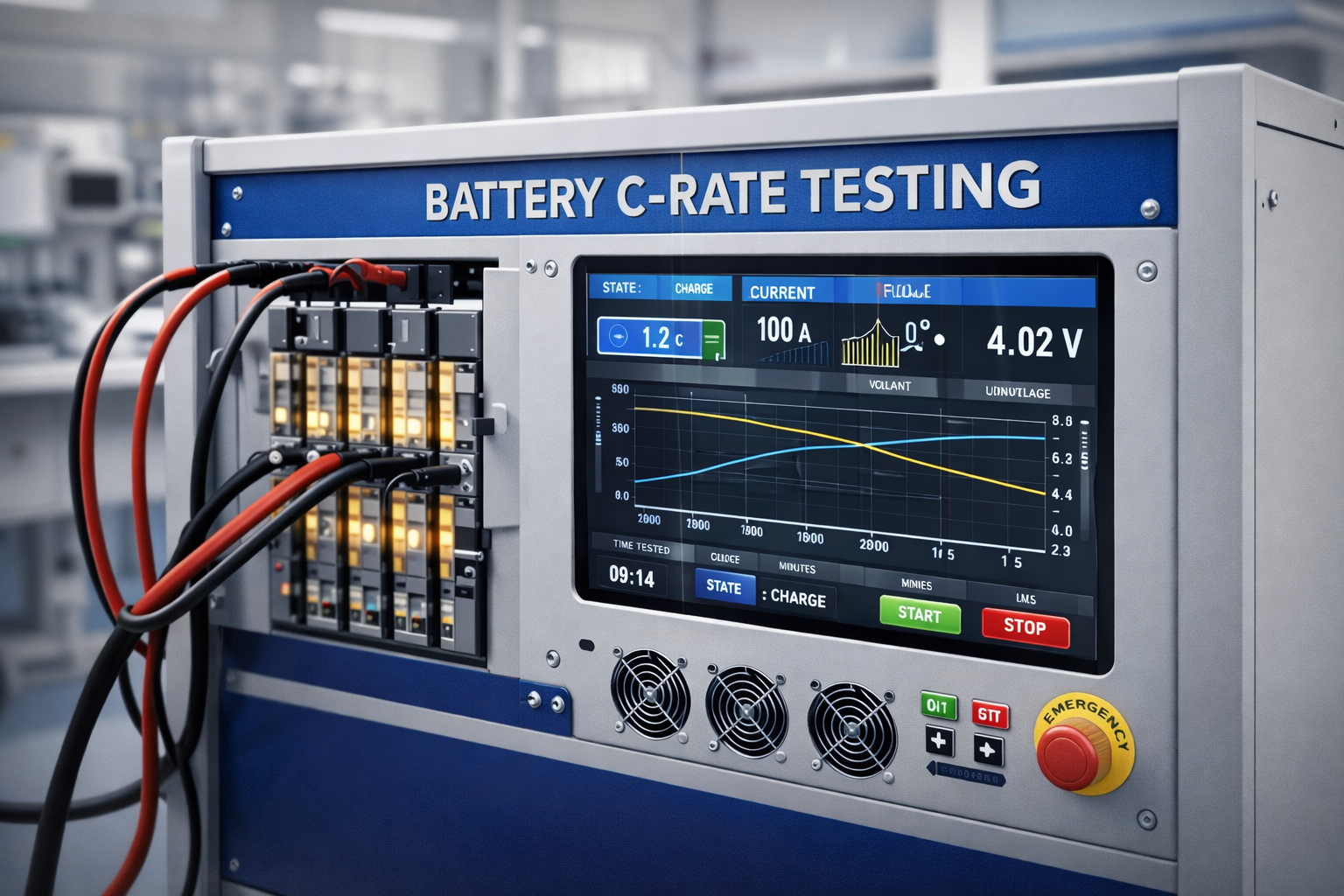
C-rate indicates how quickly a battery charges or discharges relative to its total capacity. A 1C rate means the battery is fully charged or discharged in one hour, so a 500 kWh battery charging at 1C draws 500 kW. A 0.5C rate would draw 250 kW over two hours. Higher C-rates deliver more power but typically accelerate degradation; most commercial BESS are designed to operate at 0.25C–1C for optimal cycle life.
State of Charge (SoC) and State of Health (SoH)
SoC is the real-time measure of how much energy is currently stored (like a fuel gauge). SoH tracks long-term degradation — how much of the original capacity remains after years of use.
Battery Chemistry Options: Choosing the Right Technology
Not all batteries are alike. The choice of chemistry affects performance, safety, cost, lifetime, and best-fit application. Here are the dominant technologies in commercial and industrial deployment today.
Lithium Iron Phosphate (LFP)
The current industry workhorse for stationary battery energy storage.
LFP has become the dominant chemistry for commercial and utility-scale BESS for compelling reasons:
- Safety: The iron-phosphate bond is thermally stable. LFP cells are highly resistant to thermal runaway, the uncontrolled, self-sustaining exothermic reaction that is the primary fire risk in battery systems.
- Cycle life: LFP typically achieves 5,000–10,000+ cycles, making it well-suited to daily-cycling applications.
- Calendar life: Systems are routinely designed for 15–20-year operational lifespans.
- Cost trajectory: LFP cell prices have fallen dramatically, driven by Chinese manufacturing scale.
Best for: Grid-scale storage, commercial demand charge management, behind-the-meter solar-plus-storage, microgrids.
Example: A 500 kW / 2 MWh LFP system installed at a food processing facility cycled daily for demand charge management would typically carry a 10-year performance warranty and be expected to deliver 80%+ of its original capacity over that period.
Nickel Manganese Cobalt (NMC)
NMC offers higher energy density than LFP, more energy stored per kilogram, making it attractive where space is constrained. It is commonly used in electric vehicles and some behind-the-meter commercial applications.
However, NMC is less thermally stable than LFP and has a shorter cycle life, which has led many stationary storage developers to favor LFP as costs have converged.
Best for: Applications where energy density is at a premium (e.g., urban deployments with tight footprints).
Flow Batteries (Vanadium Redox, VRFB)
Flow batteries store energy in liquid electrolyte tanks rather than solid electrodes. The key characteristic: energy and power are fully decoupled. You scale energy by adding electrolyte volume; you scale power by sizing the cell stack.
Flow batteries offer:
- Near-unlimited cycle life (the electrolyte doesn’t degrade in the same way solid electrodes do)
- Independent scaling of energy and power
- Long duration capability (4–12+ hours) at competitive cost
Best for: Long-duration storage applications (8+ hours), applications requiring very long asset lives (25+ years), projects where levelized cost over many cycles matters most.
Practical example: A vanadium redox flow battery installed at a utility substation for 8-hour grid shifting, cycling daily for 25 years, may offer a lower total cost of ownership than an LFP system despite higher upfront capital cost, because the electrolyte retains its capacity indefinitely.
Sodium-Ion (Na-ion)
No longer simply “emerging,” sodium-ion has crossed into genuine commercial deployment. Sodium is far more abundant and geographically distributed than lithium, extractable from seawater and brines globally, which offers meaningful supply chain resilience compared to lithium-ion chemistries.
For stationary storage, sodium-ion’s most compelling differentiators are its safety profile and its thermal performance. The chemistry exhibits improved thermal stability compared to lithium-ion, with lower peak temperatures during thermal runaway events, a meaningful advantage in density-constrained or safety-critical environments. It also operates efficiently across a wide temperature range, maintaining strong capacity at low temperatures where lithium-ion degrades significantly, and it can operate without the auxiliary cooling systems that LFP typically requires in hot climates, potentially saving $5–$10/kWh in cooling-related capital and operating costs.
The trade-off is energy density: sodium-ion cells currently store less energy per kilogram than LFP, which limits their appeal in applications where footprint is at an absolute premium. Cost per kWh also remains higher than mature LFP in 2026.
Best for: Data centers and critical facilities where safety and fast high-power discharge are priorities; cold-climate deployments; applications where supply chain independence from lithium markets is a strategic concern; medium-scale C&I backup (100 kW–10 MW range).
Practical example: A hyperscale data center operator deploying a sodium-ion UPS and backup power system gains several advantages over a comparable LFP installation. The improved thermal stability reduces fire suppression requirements and simplifies permitting in jurisdictions that have tightened restrictions on lithium storage following high-profile incidents.
Lead-Carbon and Advanced Lead-Acid
Mature, low-cost technology with a well-understood degradation profile. Used in some backup power and UPS applications. Generally less competitive than LFP for cycling applications due to shorter cycle life and lower efficiency, but remains relevant where capital cost minimization outweighs all other factors.
How the Battery Energy Storage System Components Work Together
Understanding how the subsystems of a BESS interact is essential for developers and facility managers who need to evaluate, procure, or operate these assets.
Battery Management System (BMS)
The BMS is the safety brain of the battery. It monitors:
- Voltage of individual cells and cell groups
- Temperature at multiple points throughout the pack
- Current flow in and out
- State of Charge and State of Health estimates
- Cell balancing — redistributing charge between cells to prevent imbalance
The BMS enforces operating limits. If a cell approaches an unsafe temperature, the BMS will curtail charging or trigger shutdown. In a multi-megawatt system, the BMS architecture is hierarchical: cell-level boards report to module-level controllers, which report to a rack-level or system-level BMS.
Power Conversion System (PCS)
The PCS, or bidirectional inverter, is the electrical interface between the DC battery and the AC grid or building load. It performs:
- Rectification: Converting AC power from the grid into DC to charge the battery
- Inversion: Converting DC power from the battery into AC for discharge
- Grid synchronization: Matching the frequency and phase of the grid precisely
- Grid-forming capability (in advanced systems): Actively maintaining voltage and frequency in islanded or microgrid configurations
Modern PCS units are four-quadrant devices capable of both real power (kW) and reactive power (kVAR) control, the latter being valuable for power factor correction and grid support services.
Energy Management System (EMS)
The EMS is the strategic intelligence of the BESS. It determines when and how much to charge and discharge based on:
- Real-time utility rate signals (time-of-use pricing, demand charge intervals)
- Revenue optimization algorithms (wholesale market prices, ancillary service signals)
- Solar or wind generation forecasts
- Building load forecasts
- Battery SoC and SoH data from the BMS
- Grid operator dispatch signals
A sophisticated EMS can simultaneously optimize across multiple value streams, for example, charging from solar during the day, providing frequency regulation in real time, and discharging for peak shaving during the evening demand peak.
Thermal Management System
Temperature is the single greatest enemy of battery longevity. Every degree above optimal operating temperature accelerates degradation. BESS thermal management approaches include:
- Air cooling: Lower cost, suitable for moderate climates and lower-power applications
- Liquid cooling: Higher cost but more precise, preferred for high-power, high-density systems and hot climates
- Heating systems: Required in cold climates to prevent lithium plating during charging at low temperatures
All-in-one BESS: Typical Battery Room Layout
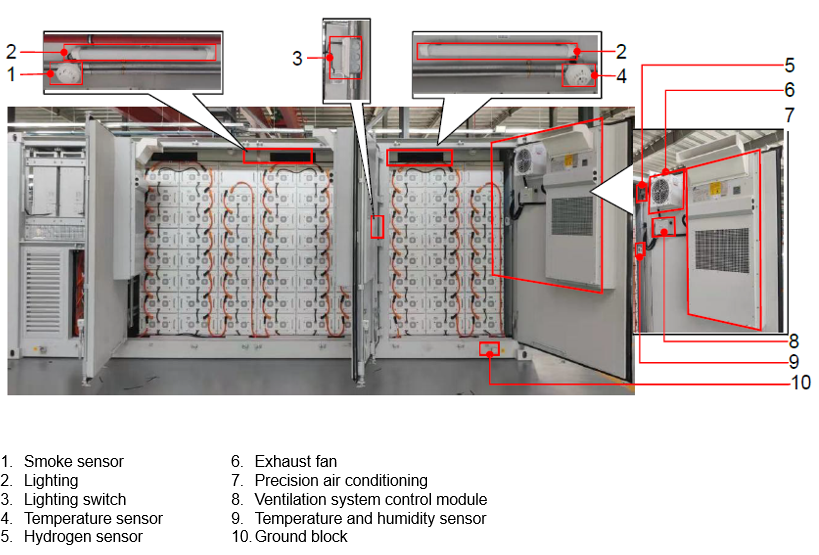
All-in-one BESS: Typical Electrical Room Layout
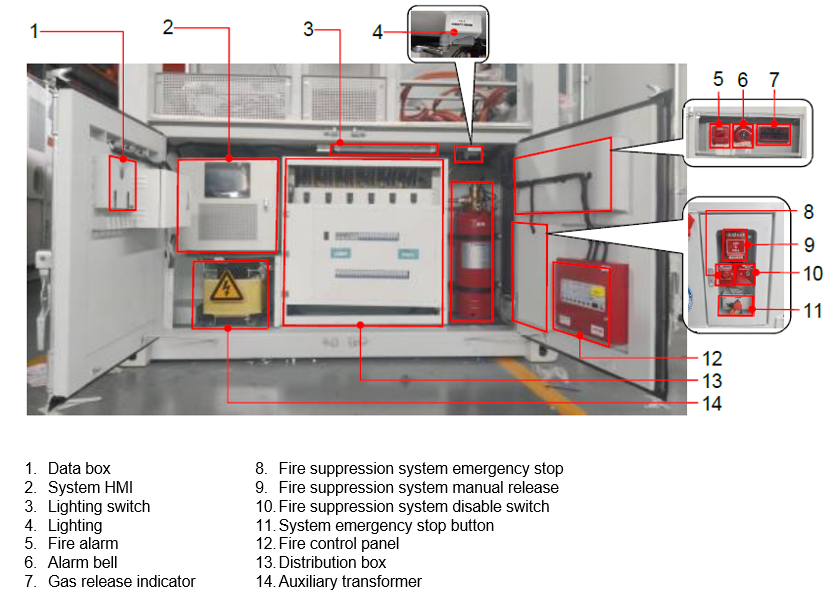
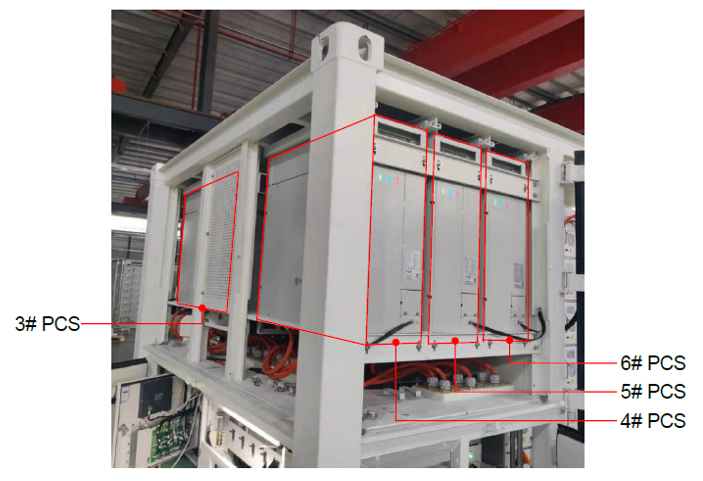
All-in-one BESS: Typical PCS Room Layout
How BESS Creates Value: The Revenue and Cost Reduction Streams
Understanding the value proposition of a BESS is where the technology meets business strategy. A well-designed system can capture value from multiple simultaneous sources.
1. Demand Charge Management
For commercial and industrial customers, demand charges, fees based on peak power consumption measured in 15- or 30-minute intervals, can represent 30–60% of a total electricity bill. A single brief peak (a production line startup, an HVAC surge) can set the demand charge for the entire month.
A BESS deployed for demand charge management monitors real-time consumption and discharges whenever power demand approaches the threshold, shaving the peak before the meter registers it.
Practical example: A cold storage facility in Texas pays $18/kW/month in demand charges. Their peak demand is typically 800 kW. By deploying a 200 kW / 400 kWh BESS, they reduce their billing peak to 600 kW, saving $3,600/month, or $43,200/year in demand charges alone.
2. Energy Arbitrage / Time-of-Use Optimization
Under time-of-use (TOU) tariffs, electricity prices vary by time of day, often dramatically. A BESS can charge during cheap off-peak hours (often overnight) and discharge during expensive peak hours (typically late afternoon and evening), capturing the price spread.
Practical example: A manufacturing plant on a TOU rate pays $0.08/kWh overnight and $0.28/kWh during the 4–9 PM peak window. A 500 kWh BESS charged overnight and discharged during the peak window earns a $0.20/kWh spread, $100/day, or approximately $18,000–$20,000/year, before considering demand charge savings.
3. Backup Power and Resilience
For facilities where power outages carry significant costs, data centers, hospitals, food processing plants, semiconductor fabs, a BESS provides seamless transition to battery power during outages. Unlike diesel generators, which take 10–30 seconds to start (often requiring a UPS bridge), a battery-backed system can switch in under 20 milliseconds.
Combined with on-site solar, a BESS enables islanding, the ability to disconnect from the grid entirely and operate indefinitely on renewable generation plus storage.
4. Frequency Regulation and Ancillary Services
Grid operators must maintain grid frequency at exactly 60 Hz (or 50 Hz in some regions). Any imbalance between generation and load causes frequency to drift. Battery storage, with its millisecond response capability, is ideally suited to provide frequency regulation, rapidly injecting or absorbing power to correct frequency deviations.
In organized wholesale electricity markets (PJM, CAISO, ERCOT, etc.), frequency regulation is a compensated ancillary service. Developers can participate in these markets and receive capacity and performance payments.
Practical example: A 10 MW / 10 MWh BESS co-located with a wind farm in PJM participates in the RegD frequency regulation market, earning an average of $80,000–$150,000/year in regulation revenues on top of any energy arbitrage value.
5. Capacity Markets and Resource Adequacy
Many electricity markets compensate resources simply for being available, capacity payments. A BESS that can commit to being available during defined stress events (typically summer afternoons) earns capacity market revenues, improving project economics even before it dispatches a single megawatt-hour.
6. Renewable Integration and Solar Firming
For solar developers, the intermittency of generation, clouds, nightfall. limits the dispatchability and thus the bankability of a project. Pairing solar with storage allows developers to firm the output, delivering a predictable, contracted power profile to offtakers.
This transforms a variable renewable asset into a firm, dispatchable resource that can compete for power purchase agreements (PPAs) that demand guaranteed delivery.
BESS in the Context of Broader Energy Systems
Behind-the-Meter vs. Front-of-the-Meter
Behind-the-meter (BTM) systems are installed on the customer side of the utility meter. They reduce the customer’s electricity bill and provide backup power. Retail electricity rates and demand charges drive the project economics.
Front-of-the-meter (FTM) systems connect directly to the distribution or transmission grid. They are typically utility-owned or developer-owned and participate in wholesale electricity markets. Wholesale energy prices, capacity payments, and ancillary service revenues drive project economics.
Many of the most sophisticated projects today are hybrid, co-located with generation assets (solar, wind, gas peakers) and participating in both retail and wholesale markets.
Microgrids
A microgrid is a locally controlled energy system that can operate connected to the main grid or in island mode, disconnected and self-sufficient. Battery storage is almost always the linchpin of a microgrid, providing the balancing power needed to match local generation to local load moment by moment.
Microgrids are deployed at military bases, university campuses, industrial parks, island communities, and critical facilities. They represent the highest-value application of BESS from a resilience perspective.
Virtual Power Plants (VPPs)
A VPP aggregates multiple distributed energy resources: rooftop solar, battery energy storage systems, smart thermostats, EV chargers, and coordinates them to behave like a single, dispatchable power plant. Battery storage systems enrolled in a VPP can receive dispatch signals from an aggregator and be compensated for their grid services, creating a revenue stream that wouldn’t be accessible to a single small system acting alone.
Common Misconceptions About Battery Energy Storage
“Batteries are just for solar projects.” While solar-plus-storage is a powerful combination, BESS creates significant value in facilities with no on-site generation, purely through demand management and TOU arbitrage against grid electricity.
“Batteries will replace the grid.” Not in any near-term scenario. BESS is a complement to the grid, not a replacement. Even in microgrid applications, grid connection remains valuable for resilience backup and cost optimization.
“Bigger is always better.” Oversizing a BESS increases capital cost without proportional value. The goal is to right-size the system to the specific value streams being targeted. An oversized system for demand management will have excess capacity that sits idle and degrades.
“Batteries degrade too fast to be economical.” Modern LFP systems carry 10-year performance warranties that guarantee 70–80% of the original capacity. With proper thermal management and operating protocols, systems routinely outperform warranty guarantees. Degradation is predictable and can be modeled with high confidence in economic pro formas.
What’s Driving the Next Decade of Battery Storage Growth
Several converging forces are accelerating battery storage deployment at a pace few industries have ever witnessed:
Falling costs: Lithium-ion battery pack prices have fallen approximately 90% over the past decade. Continued declines are expected, driven by manufacturing scale, chemistry improvements, and supply chain maturation.
Policy tailwinds: The U.S. Inflation Reduction Act, the EU Battery Regulation, and comparable policy frameworks globally are providing durable investment incentives and supporting supply chain development.
Grid stress: Aging grid infrastructure, the retirement of firm fossil generation, and the rapid addition of variable renewables are creating grid conditions where fast-responding storage is increasingly indispensable.
Electrification: The electrification of transportation, heating, and industrial processes is dramatically increasing electricity demand and peak load variability, creating larger addressable markets for storage.
Long-duration storage: Beyond 4-hour lithium-ion systems, a new generation of long-duration technologies (8–100+ hours), flow batteries, iron-air batteries, compressed air, and pumped hydro, is maturing. These technologies unlock new grid applications that short-duration batteries cannot serve.
Closing Thoughts
Battery energy storage is not a future technology, it is a present-day asset class delivering measurable financial returns to commercial and industrial facilities, generating new revenue streams for energy developers, and playing an increasingly critical role in the clean energy transition.
The fundamentals are knowable. The economics are modelable. The technology is proven. What separates the organizations capturing value from BESS today from those who will wish they had started sooner is the decision to move from passive understanding to active evaluation.
For commercial and industrial facilities, the next step is a 12-month interval data analysis paired with a utility tariff review, the two inputs that will tell you whether demand charge management or TOU arbitrage is the most compelling entry point for your operation.
For developers, the opportunity lies in understanding which value streams are available in your target market, how to stack them in a financial model, and how to structure offtake or market participation agreements that bankroll the asset.
Battery energy storage rewards those who understand it deeply. This guide is your starting point.