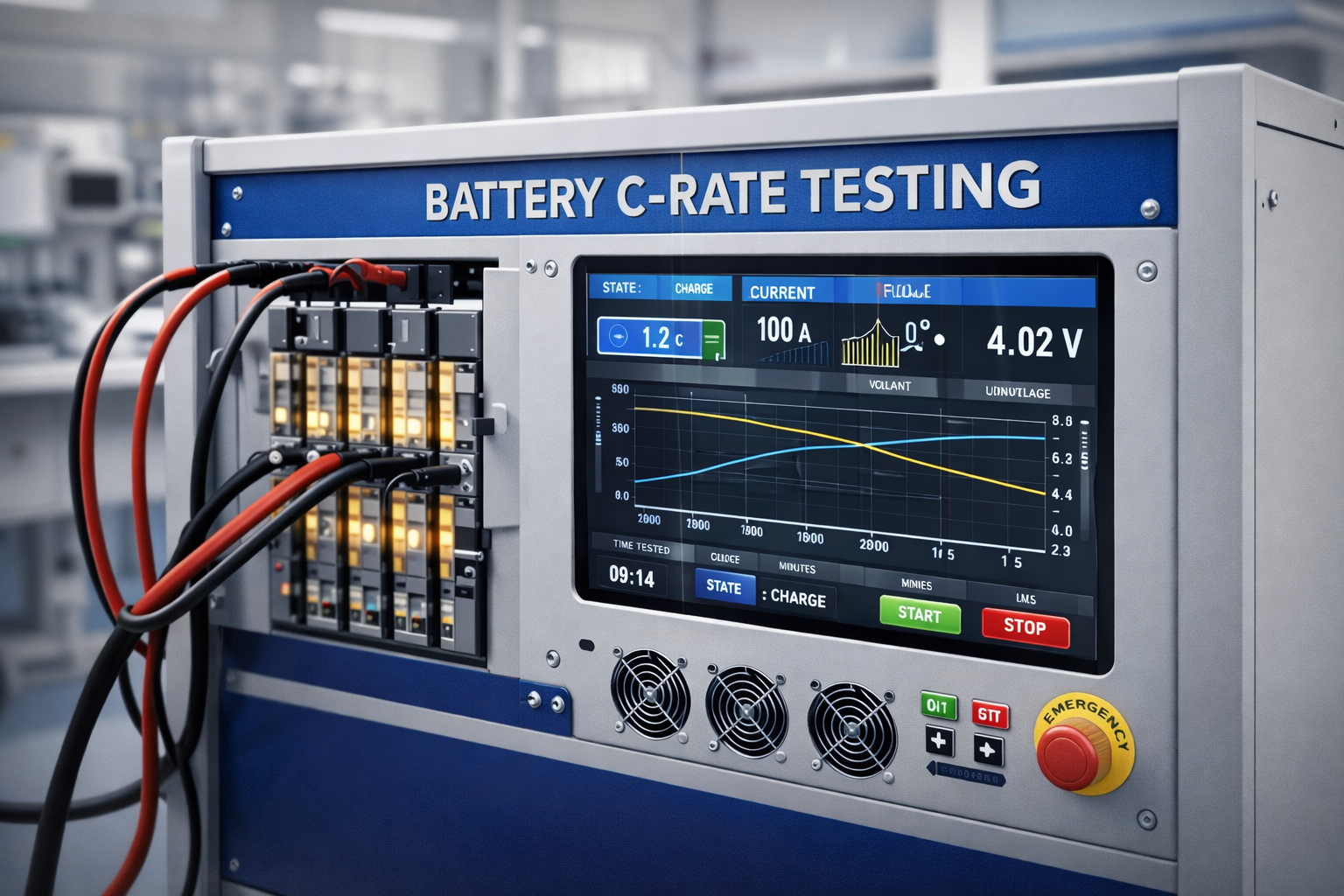
Battery C-Rate: The Complete Guide for Energy Storage Professionals
If you’ve spent any time in battery energy storage systems (BESS), you’ve encountered the term C-rate in spec sheets, procurement contracts, degradation models, and operational dashboards. Yet it’s one of those terms that’s used constantly but rarely explained with the precision that real-world applications demand.
C-rate is not just a technical footnote. It is the single most important parameter for understanding how a battery is being used, how fast it will degrade, and whether a system is genuinely fit for its intended purpose. Whether you’re a developer sizing a co-located storage project, an asset manager optimizing dispatch, or an engineer reviewing thermal management requirements, a firm grasp of C-rate will sharpen every decision you make.
This guide covers the concept from first principles, with practical calculations, real-world examples across project types, and the nuances that experienced practitioners need to know.
What Is C-Rate? The Fundamental Definition
The C-Rate Formula
C-rate is a measure of the rate at which a battery is charged or discharged relative to its maximum capacity. It is defined as:
C-Rate = Current (A) ÷ Nominal Capacity (Ah)
Or equivalently, in power terms:
C-Rate = Power (kW or MW) ÷ Energy Capacity (kWh or MWh)
A 1C rate means the battery is being fully charged or discharged in exactly one hour. A 0.5C rate means a full charge or discharge takes two hours. A 2C rate means a full cycle completes in 30 minutes.
The “C” itself stands for Capacity, it is not a unit of measurement like volts or amps, but a ratio that normalises power against the energy stored.
An Intuitive Way to Think About Battery C-Rating
Think of a battery like a water tank. Capacity is the total volume of water it holds. C-rate is how fast you’re filling or draining it, expressed as a fraction of the total volume per hour.
- Drain the whole tank in one hour → 1C
- Drain it gently over four hours → 0.25C
- Try to drain it in 15 minutes → 4C
The faster you drain the tank, the more stress you put on the pipes and the pump. Batteries behave the same way: the higher the C-rate, the more heat is generated, the more lithium ions are forced through the electrode structure per unit time, and the more accelerated the degradation.
Battery C-Rate in Practice: Worked Examples
Example 1: A 100 kWh / 100 kW System (1C)
This is one of the more common configurations in commercial-scale BESS projects: a system with equal power and energy ratings.
- Energy Capacity: 100 kWh
- Power Rating: 100 kW
- C-Rate: 100 kW ÷ 100 kWh = 1C
- Time to Full Discharge: 1 hour
This is a standard “one-hour battery”, the workhorse configuration for peak shaving, demand charge management, and many grid services.
Example 2: A 250 kWh / 500 kW System (2C)
- Energy Capacity: 250 kWh
- Power Rating: 500 kW
- C-Rate: 500 kW ÷ 250 kWh = 2C
- Time to Full Discharge: 30 minutes
This is a high-power, fast-discharge system suited for frequency regulation or short-duration grid stabilisation services such as FFR (Fast Frequency Response) or DC (Dynamic Containment). The high C-rate demands more capable thermal management and typically accelerates calendar and cycle ageing.
Example 3: A 4 MWh / 1 MW System (0.25C)
- Energy Capacity: 4 MWh
- Power Rating: 1 MW
- C-Rate: 1 MW ÷ 4 MWh = 0.25C
- Time to Full Discharge: 4 hours
This is a long-duration storage configuration, increasingly common in solar-plus-storage projects or wholesale energy arbitrage plays. The low C-rate means gentler cycling, slower degradation, and often a significantly longer asset life. Due to the decline in lithium prices over the last few years, longer-duration energy storage applications are starting to turn to battery energy storage systems.
Example 4: A Utility-Scale 100 MW / 200 MWh Project (0.5C)
- Energy Capacity: 200 MWh
- Power Rating: 100 MW
- C-Rate: 100 MW ÷ 200 MWh = 0.5C
- Time to Full Discharge: 2 hours
This is a “two-hour battery”, the most common configuration in utility-scale procurement globally, often sized for energy arbitrage or evening peak load support in solar-heavy grids.
C-Rating and Battery Chemistry
Not all battery chemistries respond to C-rate the same way. Understanding how different chemistries perform under different C-rates is critical to technology selection.
Lithium Iron Phosphate (LFP)
LFP is today’s dominant BESS chemistry and performs well at moderate C-rates. Most commercial LFP systems are rated for 0.25C to 1C continuous operation, with some capable of 2C peak discharge for short durations. LFP’s flat discharge curve means its usable energy doesn’t drop off dramatically at higher C-rates, one of the reasons it has become the preferred chemistry for grid-scale applications.
NMC (Nickel Manganese Cobalt)
NMC cells offer higher energy density than LFP and can typically support higher C-rates; some EV-derived cells are rated at 3C to 5C peak. However, NMC is more thermally sensitive and carries a greater risk of thermal runaway at high C-rates, particularly at high states of charge. For stationary BESS, NMC has largely been displaced by LFP, though it remains relevant in applications where volumetric density is paramount.
Lead-Acid
Traditional lead-acid batteries are sensitive to high C-rates and suffer pronounced capacity loss (Peukert effect) when discharged rapidly. A lead-acid battery rated at 100 Ah at a 20-hour rate (C/20) may only deliver 70–75 Ah at a 1C rate. VRLA and advanced lead-carbon variants improve on this, but lead-acid remains fundamentally a low-C-rate technology. However, lead-acid batteries can deliver very high short-duration power and are therefore widely used in UPS systems and standby backup applications. In these cases, batteries may discharge at 1C–5C for a few seconds to several minutes, providing the instantaneous power needed to bridge the gap between a grid outage and generator start-up or system shutdown.
Flow Batteries (Vanadium Redox)
Vanadium redox flow batteries (VRFBs) are typically sized for 0.1C to 0.25C operation. They are inherently long-duration technologies, and the electrolyte flow rate limits high-power performance. However, they offer excellent cycle life largely independent of depth of discharge, making them compelling for applications requiring thousands of daily cycles.
Sodium-Ion (Na-Ion)
An emerging chemistry, Na-ion cells are being positioned as an LFP alternative for grid storage. Early commercial offerings support C-rates comparable to LFP, and the chemistry’s inherent thermal stability may allow higher-C-rate operation than LFP in future generations.
How C-Rate Affects Battery Degradation
This is where C-rate moves from an academic concept to an operational and commercial priority.
The Heat-Degradation Relationship
At high C-rates, internal resistance causes greater resistive heating (I²R losses). Higher temperatures accelerate two primary degradation mechanisms in lithium-ion cells:
- SEI (Solid Electrolyte Interphase) Growth: The protective layer on the anode thickens faster at elevated temperatures, consuming lithium ions and reducing usable capacity.
- Lithium Plating: At high charge C-rates (particularly at low temperatures), lithium can plate metalically on the anode rather than intercalating properly, which is irreversible and can create internal short-circuit risks.
Cycle Counting and Equivalent Full Cycles (EFCs)
Battery warranties and degradation models are typically expressed in terms of Equivalent Full Cycles (EFCs), which normalise partial cycles to their equivalent impact on a fully cycled battery.
Critically, a cycle at 2C does not count the same as a cycle at 0.5C in terms of degradation, even if the EFC count is the same. The higher thermal stress, higher peak currents, and greater likelihood of lithium plating make high-C-rate cycling more harmful per EFC than low-C-rate cycling.
Some modern BESS warranties explicitly derate the EFC allowance for cycles above a specified C-rate threshold, a nuance that is easily overlooked during contract negotiation.
Practical Degradation Rules of Thumb
While specific degradation rates depend on cell chemistry, operating temperature, and depth of discharge:
- Cycling at 2C vs 0.5C can reduce calendar life by 15–30% under equivalent EFC conditions
- Each 10°C increase in operating temperature roughly doubles the rate of capacity fade (Arrhenius relationship)
- Combining high C-rates with high SoC (State of Charge) — e.g., charging rapidly to 100% — creates a compounding degradation effect
C-Rate in System Design and Sizing
Power-to-Energy (P/E) Ratio: Another Way to Express C-Rate
In commercial and utility-scale BESS discussions, C-rate is often expressed as the Power-to-Energy ratio (P/E ratio). These are mathematically equivalent:
- A 1C battery = P/E ratio of 1:1
- A 0.5C battery = P/E ratio of 1:2 (1 MW per 2 MWh)
- A 2C battery = P/E ratio of 2:1 (2 MW per 1 MWh)
When developers discuss “a two-hour system” or “a four-hour system,” they are directly describing the inverse of C-rate.
Revenue Stack and C-Rate Alignment
The optimal C-rate for a BESS project depends on the revenue stack it’s targeting:
| Application | Typical C-Rate | Duration |
|---|---|---|
| Fast Frequency Response (FFR/DC) | 2C – 4C | 15–30 min |
| Frequency Regulation (FR/DM) | 1C – 2C | 30–60 min |
| Peak Shaving / Demand Management | 0.5C – 1C | 1–2 hours |
| Energy Arbitrage (wholesale) | 0.25C – 0.5C | 2–4 hours |
| Capacity Markets / Backup Power | 0.1C – 0.25C | 4–10 hours |
| Long-Duration Storage | 0.05C – 0.1C | 10–24 hours |
Stacking multiple revenue streams (e.g., arbitrage + FFR) creates tension in C-rate requirements. A battery optimised for 4-hour energy arbitrage may not be able to provide high-power frequency services at the required response times without exceeding its warranted C-rate.
PCS and Transformer Sizing
C-rate isn’t just a battery parameter; it cascades into the sizing of the entire power conversion chain. A 10 MWh system operating at 1C requires 10 MW of PCS power. The same system operated at 0.5C only needs 5 MW of PCS power. Since PCS, inverters, transformers, and grid connection costs are significant capital items, the chosen C-rate directly impacts overall project CapEx.
Thermal Management System (TMS) Sizing
Higher C-rates require more sophisticated thermal management. HVAC systems, coolant loops, and thermal interface materials must all be sized for the peak heat rejection load, which scales with C-rate. Under-sizing the TMS for a high-C-rate application is a common cause of accelerated degradation and warranty disputes in operational projects.
C-Rate in Warranties and Contracts
Battery warranties are among the most complex documents in the energy storage industry, and C-rate is a critical parameter in almost every warranty structure.
Warranted C-Rate Limits
Most OEM warranties specify a maximum continuous C-rate and a maximum peak C-rate (typically allowed for limited durations, e.g., 30 seconds or 5 minutes). Operating above these limits, even briefly, can void warranty coverage.
In practice, BMS (Battery Management System) settings should be configured to enforce these limits. However, edge cases, grid frequency events, control system glitches, or aggressive dispatch optimisation, can occasionally push systems beyond warranted limits, so monitoring and clamping logic is essential.
Throughput Guarantees and C-Rate Assumptions
Many capacity guarantee structures specify a total lifetime energy throughput (in kWh) over which the battery must maintain a minimum capacity (e.g., 70% of nameplate by end of warranty). These throughput figures are almost always calibrated to a specific reference C-rate.
If the actual operational C-rate is higher than the reference C-rate, the warranted throughput may need to be derated. Asset owners who operate at higher C-rates than assumed in the warranty model may find their batteries degrading faster than expected, and may have limited warranty recourse if the C-rate deviation wasn’t contractually addressed.
Negotiating C-Rate Flexibility
Sophisticated asset owners are increasingly negotiating warranty structures that provide C-rate flexibility, acknowledging that real-world dispatch will vary across a range of C-rates. Key provisions to seek include:
- EFC-based accounting rather than calendar time, to fairly represent high-C-rate usage
- Explicit throughput adjustments for C-rate bands (e.g., a multiplier applied to throughput consumed when operating above 1C)
- Peak C-rate allowances with defined durations for ancillary service provision
C-Rate in Battery Management Systems and SCADA
BMS Enforcement of C-Rate Limits
The Battery Management System is the primary technical enforcer of C-rate constraints. A well-configured BMS will:
- Monitor real-time current (and therefore instantaneous C-rate) at the cell, module, and pack level
- Implement soft limits (ramp-down commands) before hard limits (disconnection) are reached
- Adjust maximum allowable C-rate dynamically based on SoC (e.g., reducing charge C-rate near 100% SoC), temperature, and State of Health (SoH)
SCADA and EMS Dispatch Integration
At the system level, the Energy Management System (EMS) should incorporate C-rate constraints into its dispatch optimisation. This means:
- Not bidding more power into frequency markets than the C-rate limit allows for the current SoC
- Scheduling charging and discharging to avoid sustained high-C-rate operation during temperature extremes
- Logging C-rate exceedances for OEM warranty compliance reporting
In sophisticated assets, the EMS uses a dynamic C-rate envelope, the maximum allowable power as a function of temperature, SoC, and SoH, rather than a simple fixed limit.
Common Misconceptions About C-Rate
“C-Rate Is a Fixed Property of the Battery”
C-rate is a ratio, not an intrinsic characteristic. The same 100 kWh battery can operate at 0.25C, 1C, or 2C, depending on how much power is drawn from or pushed into it. What is fixed are the warranted limits, the C-rate range within which the manufacturer guarantees performance and longevity.
“1C Always Means Full Discharge in Exactly One Hour”
In practice, 1C delivers approximately one hour of capacity under standard test conditions (typically 25°C and moderate SoC). At elevated temperatures, high SoC, or with an aged battery, the actual energy delivered at a nominal 1C rate may differ. The rated capacity used in the C-rate denominator is the nameplate capacity, not the real-time usable capacity.
“Higher C-Rate Always Means More Revenue”
Higher C-rates enable participation in higher-value, shorter-duration markets (e.g., FFR). But the accelerated degradation, higher capital cost (inverter sizing), and warranty implications can easily erode the additional revenue. The optimal C-rate is always a whole-of-life economic calculation, not simply a peak revenue maximisation exercise.
“C-Rate Doesn’t Matter if You’re Only Doing Partial Cycles”
Even if a battery rarely reaches full charge or discharge, high instantaneous C-rates during partial cycles still generate heat and stress. A battery that charges from 20% to 80% SoC at 2C experiences the same instantaneous current as a full 0-to-100% cycle at 2C, and the degradation per unit of throughput is comparable.
Closing Thoughts
C-Rate is a design philosophy, not just a number. Understanding C-rate is not about memorising a formula. It’s about internalising the relationship between power, energy, time, and longevity, and applying that understanding consistently across design, procurement, operations, and asset management.
Every time you look at a BESS spec sheet, a dispatch profile, a warranty document, or an optimisation model, C-rate is embedded in the assumptions. The professionals who understand it deeply, who can quickly assess whether a proposed operating regime is sustainable, whether a warranty structure fairly accounts for real-world usage, or whether a sizing decision is leaving revenue on the table, are the ones who build better projects and manage better assets.
For battery energy storage, C-rate isn’t just a technical parameter. It’s a lens through which the entire system makes sense.